
In this episode of On the Record, brought to you by Associated Equipment Distributors, we look at the retaliatory tariffs Canada is enacting on U.S. goods, effective September 8. In the Technology Corner, Noah Newman shares how precision dealers measure a successful customer clinic. Also in this episode, a look at the trends Deere is seeing in its early order See & Spray and planter programs and the impact severe weather is having on harvest in Europe.
.png)
This episode of On the Record is brought to you by Associated Equipment Distributors — the leading association in North America for the equipment distribution industry.
Power up your Q3 with AED’s must-attend lineup of leadership events, industry conferences, and hands-on training built to connect and elevate equipment professionals. From the high-impact Leadership Conference to the Women in Equipment Conference, plus expert-led seminars and certification programs, AED delivers real-world insights, skill-building, and unmatched networking opportunities that drive performance and growth. Whether you’re developing your team, staying ahead of industry trends, or building stronger relationships, AED’s Q3 programming gives you the edge to compete in today’s economic challenges. Learn more at www.aednet.org.
TRANSCRIPT
Jump to a section or scroll for the full episode...
- Canada Imposes Retaliatory Tariffs on Ag Equipment
- Commodity Ticker
- Precision Dealers Discuss How to Quantify a Successful Customer Clinic
- Deere Reports Growth in See & Spray & Planter Technology Adoption
- EU Summer Crop Yields Fall Below 5-Year Average Amid Severe Weather
- DataPoint: Capital Purchases vs. Annual Net Farm Income on Illinois Grain Farms
Canada Imposes Retaliatory Tariffs on Ag Equipment
New tariffs went into effect on August 22 on billions of dollars’ worth of U.S. imports from Canada after trade talks between the neighboring countries collapsed.
According to an August 25 Wall Street Journal report, Canada intends to impose retaliatory tariffs starting Sept. 8. Those tariffs will be concentrated in sectors like ag machinery, along with steel, dairy, paper and electronics.
AEM’s Senior Vice President of Government and Industry Relations Kip Eideberg, said in a statement,
“The United States and Canada have built the world's most integrated manufacturing ecosystem, supporting jobs, driving investment, and powering economic growth across North America. Continued trade uncertainty and escalating tariffs create serious challenges for manufacturers and the businesses that depend on cross-border supply chains. We urge U.S. and Canadian officials to return to the negotiating table, remove harmful tariffs, and secure a path to preserve and strengthen the USMCA.”
In a statement Brian McGuire, president and CEO of AED, expressed the trade group’s disappointment that the U.S. and Canada could not come to an agreement. He said,
“AED has always had a stance supporting free and fair trade in North America, as the best means for achieving economic prosperity and growth in the sectors our members serve. Tariffs and retaliatory tariffs damage the economies on both sides of the border. Any measures that target equipment that builds, feeds and fuels both countries are detrimental regardless of if they're imposed by Canada or the United States. AED will continue to work with officials and political leaders on both sides of the border to encourage a return to the bargaining table.”
We'll have more on the impacts in the September edition of Ag Equipment Intelligence.
Commodity Ticker
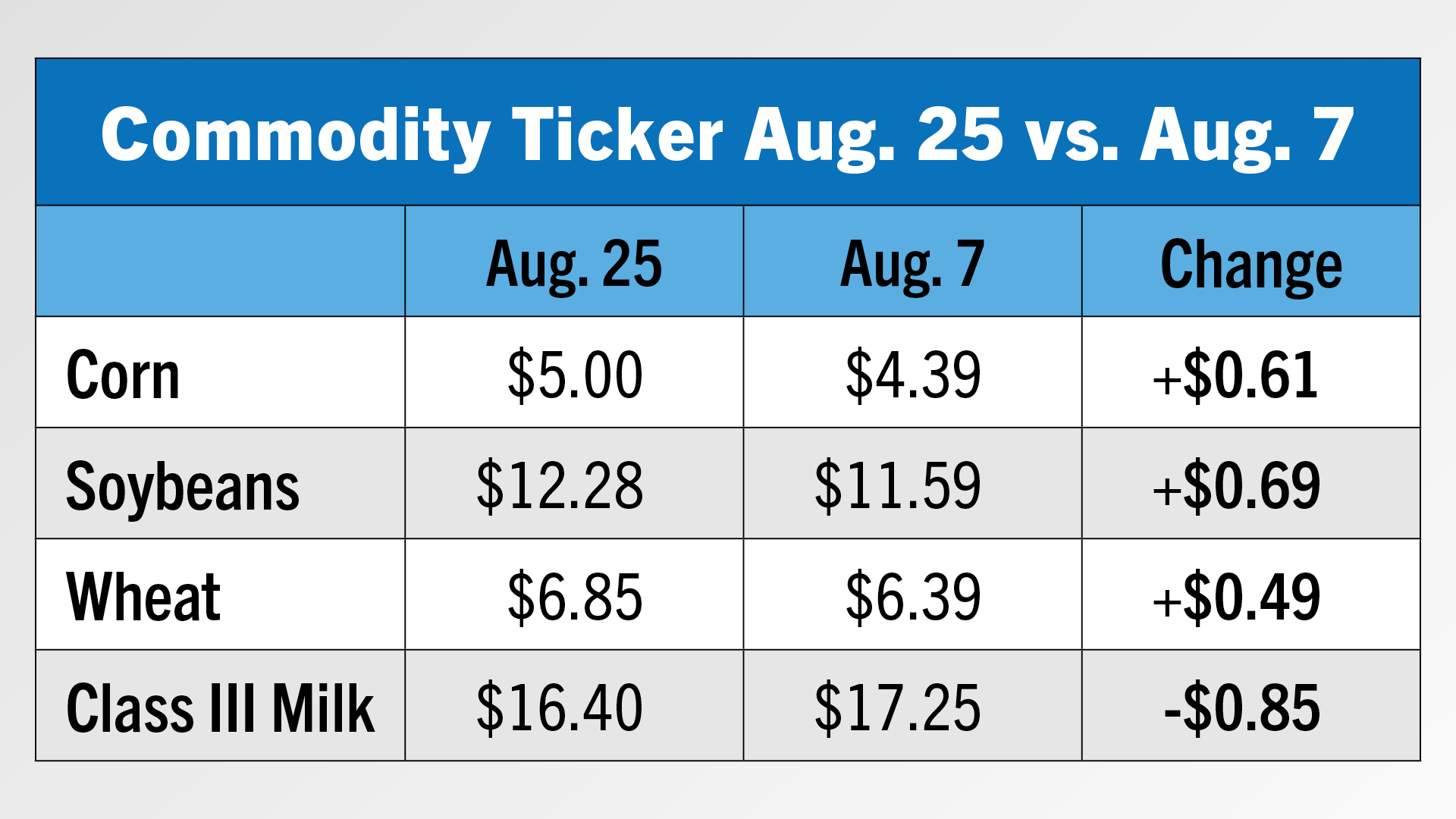
As of Aug. 25 corn prices were $5.00, up 61 cents from our last episode. Soybeans closed at $12.28, up 69 cents. Wheat closed at $6.85, up 46 cents and Class III milk prices closed at $16.40 down $0.85.
Precision Dealers Discuss How to Quantify a Successful Customer Clinic
In a rapidly evolving precision landscape, dealers must go beyond the sale to build long-term relationships with customers. And of course, clinics and demo days are great ways to drive customer engagement. At the 2026 Precision Farming Dealer Summit, dealers discussed the dos and don’ts of customer clinics. AGCO product specialist Mason Gukenberger, who worked for Swiderski Equipment at the time, shared his tips for a successful clinic.
“Start small and be intentional. Tie clinics to seasons and not calendars, so meaning try to plan in advance. Don't try to react. If you're going into planting season, that is probably not necessarily the time to do the planter clinics like we're doing ours next week to get the customers ready for planting so then you're proactively thinking forward. Measure success by fewer problems and more adoption across your technology side of your business, not necessarily more attendance. Having 150 customers at a clinic and having one walk away with it isn't as powerful as having 30 people at a clinic or even five people at a clinic or a demo and having all five walk away with something. Engagement also works best when it's repeatable and expected, meaning you can repeat the experience that the customer walks away with and they're walking away with a value to that piece.”
“The other thing I also want to say that's not on here is when you demo every single product, one thing we've learned, if you demo every feature or every functionality of a piece in the same demo or in the same clinic, you're not really educating that customer or that individual on anything, you're probably going to be adding more work to your precision team later because they didn't walk away with anything other than, “Hey, I can do this,” versus, “This is how you do it.”
Customer clinics are sure to be another hot topic at the 2027 Precision Farming Dealer Summit, Jan. 11 in Indianapolis. Sign up at PrecisionSummit.com!
Deere Reports Growth in See & Spray & Planter Technology Adoption
Customers are using John Deere’s See & Spray technology on significantly more acres year-over-year, Deanna Kovar, president of Worldwide Ag & Turf Division, said during Deere's Q3 earnings call on August 20. And they are achieving more than 50% savings on herbicide, she says.
Kovar says Deere’s current early order program trends suggest factory adoption of See & Spray will nearly double with the technology included on about a third of Norther American sprayers on order.
Similarly, Kovar says the OEM is seeing strong momentum and consistent adoption patterns on its next-generation planter technologies.
She says quote, “You'll remember that we launched our industry-leading ExactEmerge planters over a decade ago and are seeing continued pull for this technology. On these planters, customers are choosing even more advanced offerings to support input cost savings, productivity and yield benefits.”
For model year '27, Deere is seeing more than 40% of North American planters including its next generation of advanced offerings such as ExactRate, ExactShot and FurrowVision.
According to Kovar, Deere now has more than 520 million engaged acres across nearly 1.2 million connected machines. She says,
“Just as importantly, highly engaged acres have grown to more than 190 million acres, representing double-digit growth for the year. Through the John Deere Operations Center, we are turning this growing stream of operational data into actionable insights that help growers better understand performance across their operations.”
Kovar says Deere will soon build on that foundation with AI-enabled capabilities designed to unlock even more value from the data within Operations Center.
We will report more on this topic following next week’s Farm Progress Show.
EU Summer Crop Yields Fall Below 5-Year Average Amid Severe Weather
According to the European Union’s August 24 Joint Research Center’s MARS Bulletin, persistent heat and exceptional water deficits have substantially worsened summer crop prospects across western and most of central Europe, reducing fertility and biomass accumulation, impairing grain filling and accelerating senescence.
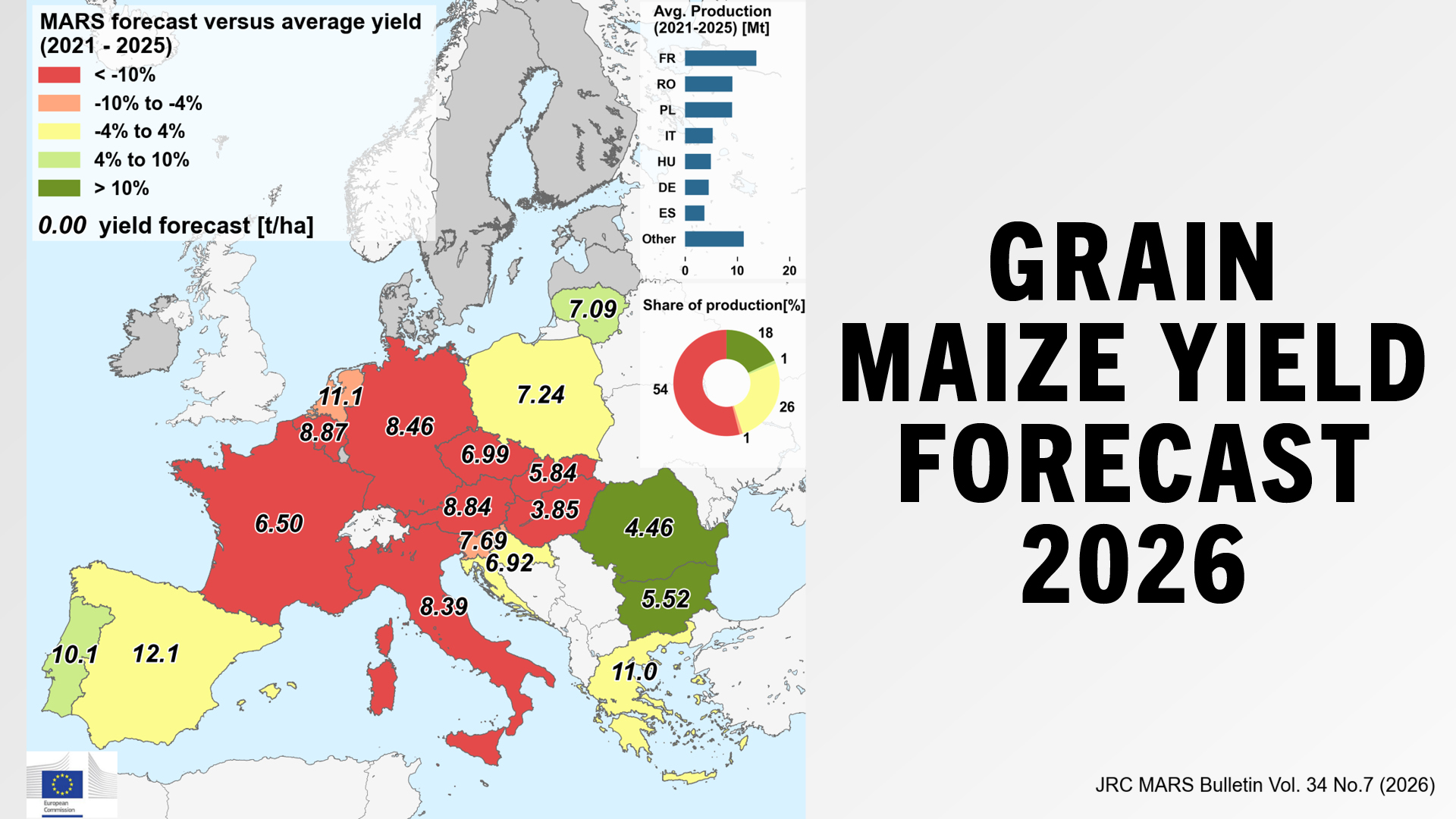
According to the report, impacts range from moderate yield reductions to severe losses, with crop failure likely in the worst-affected regions. Although summer crop conditions remain more favorable in parts of northern and eastern Europe, EU yield forecasts for all summer crops have been sharply reduced, falling below the five-year average by up to 14%.
With harvesting largely completed, yield prospects for most winter cereals have been confirmed around the five-year average at the EU level.
Cooler and wetter conditions forecast across much of western and central Europe may provide some relief, although too late to compensate for the losses already sustained. Countries listed as having severe impacts include France, southern Germany, northern and central Italy, Austria, Czechia, Slovakia, Hungary and western Romania.
On August 17, CEMA, the European Agricultural Machinery Association, released its Business Barometer. According to the report, the general business climate index for the European ag machinery industry has improved, despite remaining in negative territory. This follows the sharp declines recorded in recent months, which had pushed the sector back into recession after just over a year. The index rose from -19 to -14 points on a scale from -100 to +100.
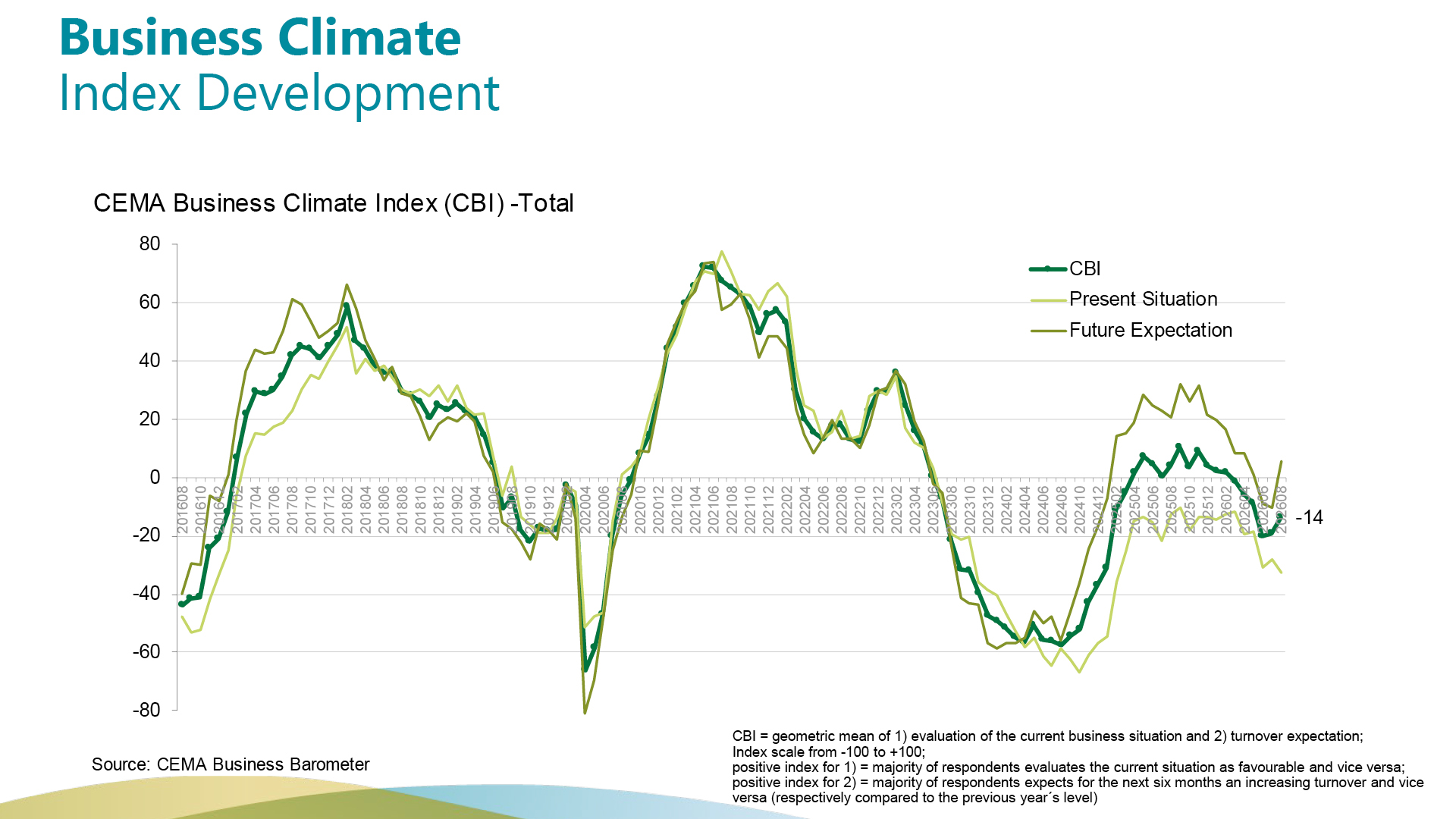
The recent downturn was driven by a marked deterioration in both the assessment of current business and turnover expectations. The improvement in July is due entirely to renewed confidence regarding the next 6 months, while current business remains weak.
With a view to the European market, Scandinavia, the UK and Ireland lead the confidence ranking, whereas negative expectations for major markets such as Poland and France have been confirmed once again.
We will watch for the September barometer, which may better show the impacts of the crop loss on sentiment in the equipment sector.
DataPoint: Capital Purchases vs. Annual Net Farm Income on Illinois Grain Farms
This week’s DataPoint is brought to you by the Precision Farming Dealer Summit, returning to Indianapolis January 11-12. Visit PrecisionSummit.com to learn more and register.
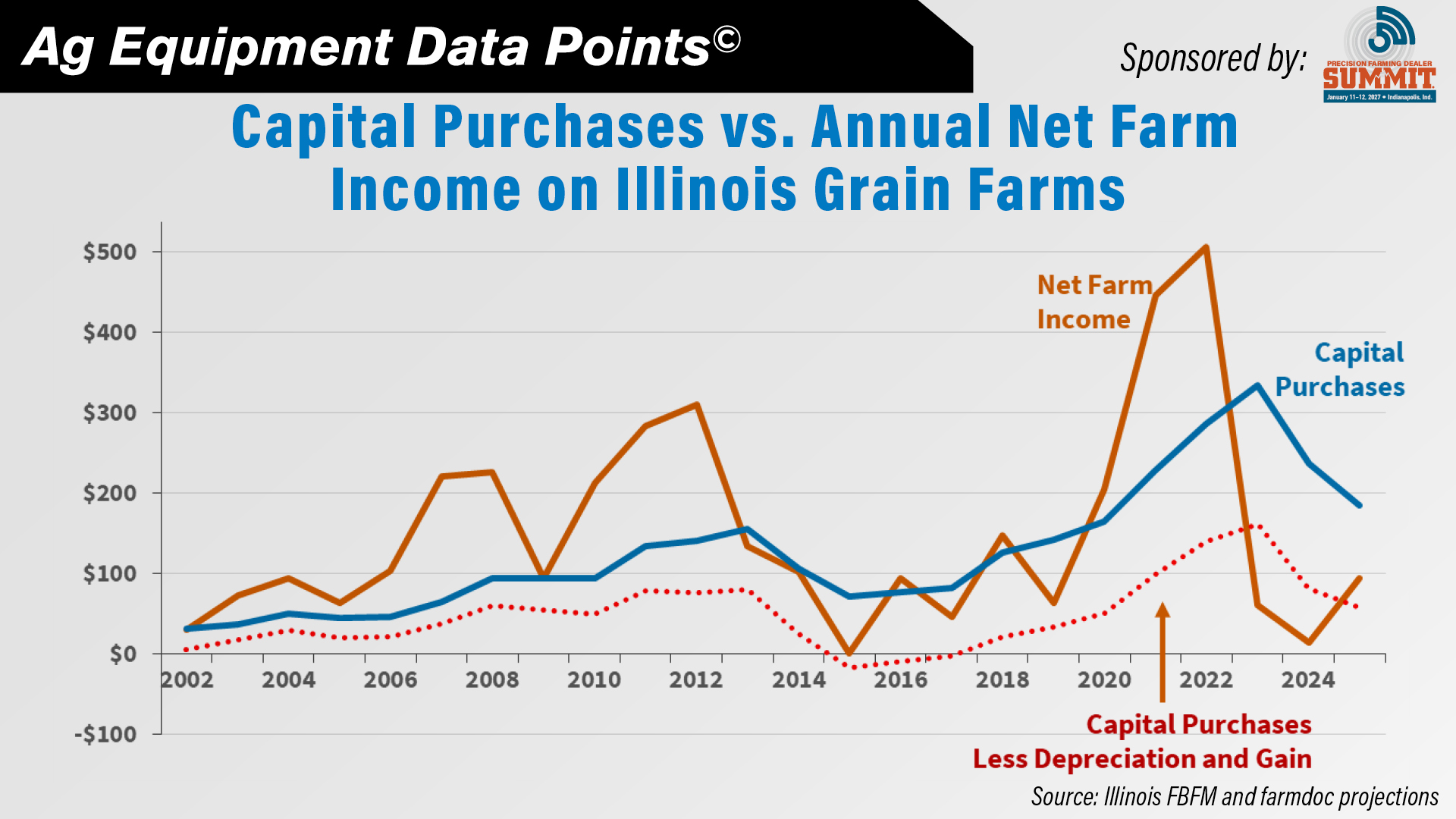
According to an August 18 report from the University of Illinois, over the past 10 years, average annual capital purchases on Illinois grain farms have exceeded average annual net farm income, with government payments included in income.
Generally, income from other sources has been used to fund farm-level capital purchases, much of which has been allocated to machinery, the authors state. Over time, machinery purchases then have resulted in growing machinery depreciation costs on a per-acre basis.
Average capital purchases on Illinois grain farms have declined from highs set in 2023, when capital purchases were $335,000 per farm. That high capital purchase value was associated with higher incomes in 2021 and 2022, when accrual net farm incomes averaged $446,000 and $505,000, respectively.
Higher capital purchases are often associated with higher net farm income, with capital purchases declining when net farm incomes decrease, often in a lagged fashion. Since 2023, capital purchases have declined to $236,000 in 2024 and $184,000 in 2025, corresponding to lower net farm incomes of $13,000 in 2024 and $93,000 in 2025.
On the Record is now available as a podcast! We encourage you to subscribe in iTunes, the Google Play Store, Soundcloud, Stitcher Radio and TuneIn Radio. Or if you have another app you use for listening to podcasts, let us know and we’ll make an effort to get it listed there as well.
We’re interested in getting your feedback. Please feel free to send along any suggestions or story ideas. You can send comments to kschmidt@lessitermedia.com.