
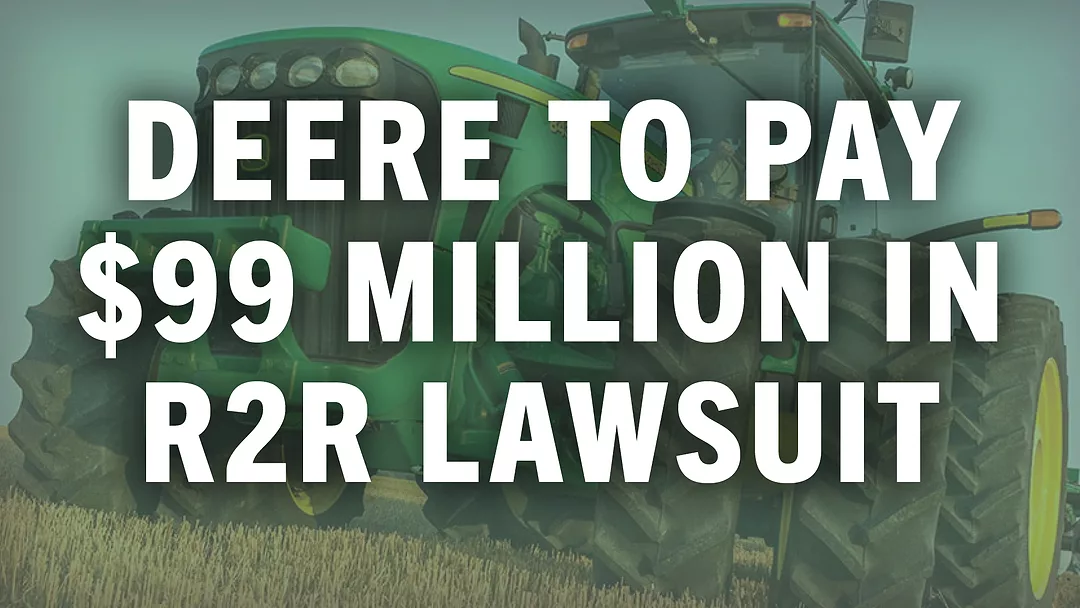
Deere’s right-to-repair saga hit a new chapter this week. The OEM announced it has agreed to pay $99 million into a settlement fund for farms and farmers that are part of a multi-district class action lawsuit filed against Deere.
The funds will be distributed to class members pursuant to a Court-approved distribution plan and used to cover administrative and legal fees. Additionally, Deere will continue to support customers and other service providers with access to repair resources, including tools, manuals, and diagnostic software.
In a statement Denver Caldwell, Deere vice president of Aftermarket & Customer Support said: “As we continue to innovate industry leading equipment and technology solutions supported by our world-class dealer network, we are equally committed to providing customers and other service providers with access to repair resources. We’re pleased that this resolution allows us to move forward and remain focused on what matters most – serving our customers.”
We checked in with Eric Wareham, senior vice president of government affairs, to get some perspective on what this means for dealers and the wider right to repair impact for the industry.
“I think it's important to note first that that settlement was a no-fault settlement, and so it doesn't signify anything about what the industry is doing or not doing to support their customers.What we've seen is lately a lot of activity on right to repair, whether it's from the administration, litigation, or legislation. And there's a lot of smoke, but I think the reality is that there's really not a lot of fire because our industry is a leading example of one that supports customer self-repair. And I think that's why we've seen the resolution of these issues. A lot of legislation has been introduced over the years, but it has passed. The legislation that has passed, the trend is that there is a non-road exemption included. And so I think that legislators and people involved in this issue that look at it understand what we're doing to support customer repair and that there is a large distinction with a difference from farm equipment to household consumer electronics like iPhones and laptops and such.”
Right-to-repair legislation continues to be introduced at the state level, and Wareham says Iowa is an important state to watch right now.
“I think Iowa is interesting because it's a case study in how the politics have changed on this issue. As I mentioned, there's seven states that have passed right to repair with a non-road exemption, and that has been the trend that's soon to be eight. Kansas is going to pass a bill with an on- road exemption this year, or just did recently. However, with the pronouncements from the administration, it's given somewhat of a green light to Republicans around the country to pursue right to repair legislation. Whether that's misguided or misconceived, it's still, I think legislators are looking for something to do on behalf of farmers in this market.”
“And I think the reality also is that we can't legislate our way out of this. We need to find markets and right to repair type legislation that's divisive and misguided is not going to do anything to help anyone. At the end of the day, we all succeed together, and so we can't circle the wagons and shoot in. We need to be constructive. And so Iowa, with its death delete and parts at cost language, tools at cost, that really is not a constructive way to approach this issue. And I think it doesn't also recognize the leaps and bounds that the industry has made in being first in class supporting self-repair. And at the end of the day, I think we're going to move past this. I think Iowa, like many other states, the legislation is probably likely to fail, but we do need to find a resolution to this that gets past the talking point and the slogan of right to repair.”
Watch the full version of this episode of On The Record


