

As spring planting season approaches, farmers across the U.S. and Canada are facing soaring fertilizer and fuel prices as the war in Iran escalates, according to a Reuters report from Naveen Thurkal and Ed White.
According to Faith Parum, Ph.D, an economist with the American Farm Bureau Federation, Iran holds some of the world’s largest natural gas reserves, and natural gas is the key feedstock used to produce ammonia, the foundational input for most nitrogen fertilizers. Urea, which contains about 46% nitrogen, is the most widely used solid nitrogen fertilizer globally and plays a central role in crop production systems.
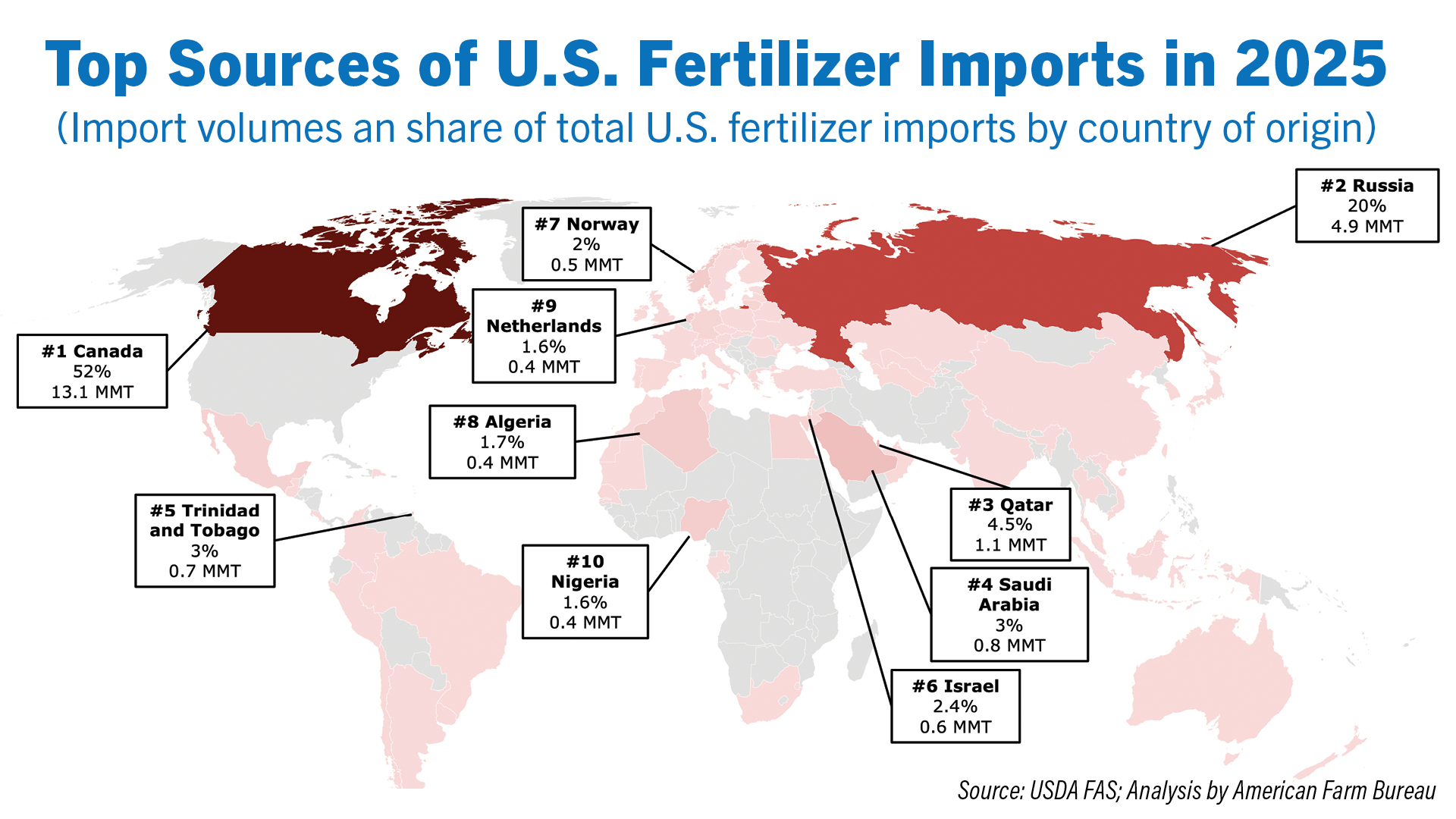
“Prices could jump higher if the Persian Gulf closure persists and shipments can’t make it in time for spring planting, analysts told Reuters. ‘Literally, this could not happen at a worse time of the year,’ said StoneX analyst Josh Linville.”
“American farmers are entering the 2026 spring planting season amid geopolitical tensions involving Iran and nearby Persian Gulf countries, which adds uncertainty to global energy and fertilizer markets,” Parum said. “This timing matters because fertilizer purchasing, field preparation and early season fertilizer applications are already underway, limiting farmers’ ability to adjust if input prices spike suddenly. Anecdotally, farmers are already considering reducing corn acres planted in exchange for crops like soybeans that are less exposed to fertilizer price volatility.”
According to Seth Meyer, former U.S. Department of Agriculture chief economist and now at the Food and Agricultural Policy Research Institute, farmers might alter crop choices and fertilizer applications due to the price spike, Thukral and White reported. “Farmers need fertilizers for virtually all their crops if they want a good yield, but each crop and the soil they are grown in have different demands. Farmers could cut back on corn, which requires high rates of nitrogen fertilizer, or else sharply reduce fertilizer application rates, Meyer said.”
Dan Basse, founder and president of AgResource, has already adjusted his projections, taking his corn planting estimate down about 1-1.5 million acres relative to the war and fertilizer.
Before the conflict with Iran escalated, Basse was projecting roughly 94.5 million acres of corn, which he’s now lowered to 93-93.5 million acres. At the same time, he has increased his expectations for soybean planting, increasing his estimate to 86.5-87 million acres.
Watch the full version of this episode of On The Record