
Editor's Note: This article was originally published in the Feb. 15, 2026 edition of Ag Equipment Intelligence. To view AEI content as it's published, you can subscribe to the monthly newsletter here.
When it comes to planting trends in 2025, no-tillers stayed fairly consistent with their corn but made some changes to their soybeans, according to the 2026 No-Till Farmer Benchmark Report.
One pattern NTF editors noticed is a growing number of no-tillers planting soybeans in narrower widths. Nearly 61% planted the crop on 15-inch rows, up 6.6 percentage points from 2024, while those planting on 30-inch rows fell 7 points to 30.8%.
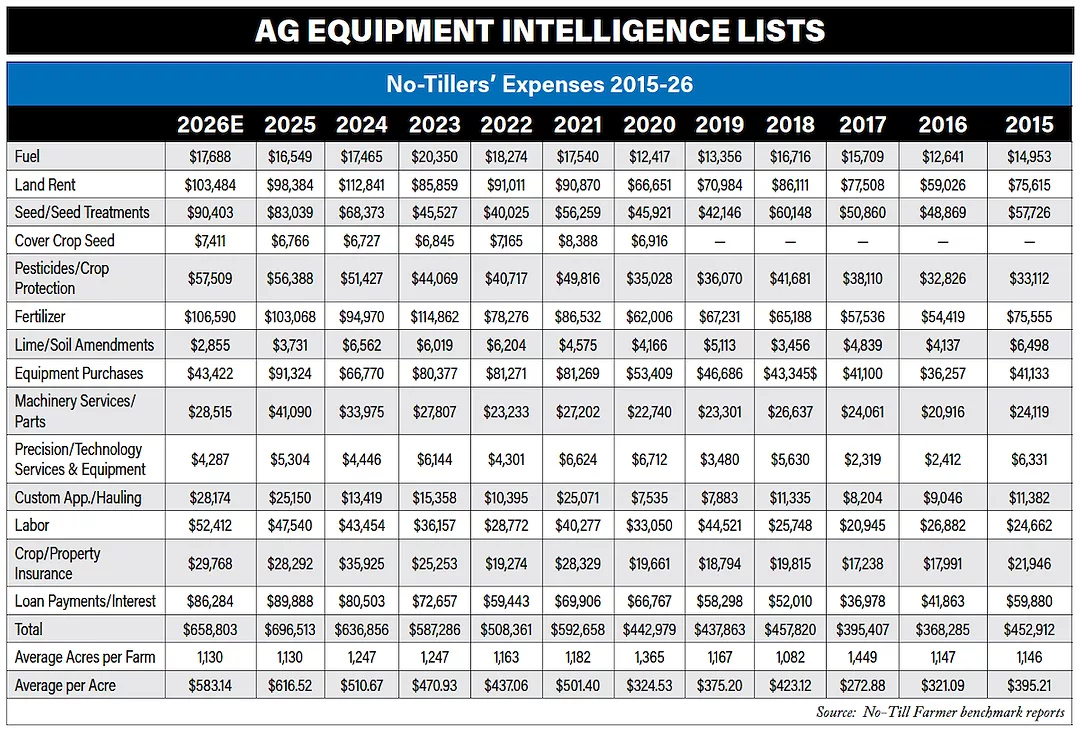
Rising pesticide costs may be the motive behind this. In 2025, no-tillers estimated spending just over $56,000 on average on crop protection expenses, while they had only anticipated spending an average $42,000-plus. That line item was also up $10,000 from the 2024 average of roughly $46,000.
Increasing seeding rates to help choke out weeds is not a profitable strategy, as no-tillers’ expenses for seed and seed treatment are also increasing. This might help explain a move to narrower rows to tighten the crop canopy and reduce weed germination.
No-tillers estimated spending over $83,000 on average for seed and seed treatment in 2025, which was over $22,000 more from the approximate $61,000 they averaged in 2024. In the 2024 No-Till Operational Benchmark Study, they predicted spending around $58,000 on these expenses in 2025.
It’s no surprise then that the average seeding rate for drilling soybeans fell nearly 3,500 seeds per acre to 147,087 when compared to 2024. Planting rates were pretty consistent at 139,415, while air seeding saw the only increase of just over 4,000 seeds per acre at an average 157,441.
How no-tillers seed soybeans did not significantly change. Planting remains the most popular method, with 70.3% using a planter, though it’s still a 5-point drop from 2022 and 2023. At the same time, drilling soybeans increased 5.1 points to 29.2%. Those air seeding soybeans were similar to 2024 at nearly 12%.
Trending Toward Smaller Planters. After seeing corn planter sizes grow from 2023 to 2024, the trend flipped in 2025. While the percentage of those with 16-row planters remained roughly the same (30.4%), those running 24-row planters fell 4.4 points to 13.8%, and those using 12-row planters grew 8.9 points to 32.6%.
No-tillers remained consistent in their planter setups in 2025. Closing wheels were still the most common no-till planter attachment and continue to grow in popularity, as 89.4% used them last year, up nearly 3 points from 2024. Those using 2-by-2-inch applicators also grew 3 points to 37.7%.
All other planter attachments remained fairly consistent to percentages we’ve seen in recent years, with about 70% running row cleaners, 64% using seed firmers, 58.9% deploying a down-pressure system, 38.6% running a no-till coulter and 33.9% applying pop-up fertilizer.
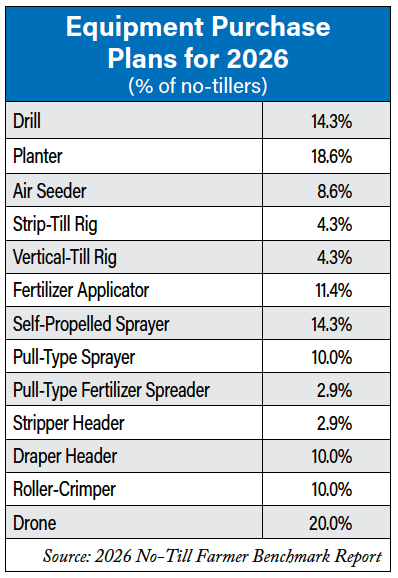
Drone Use Grows. Intentions to buy equipment continue to fall, which is not unexpected since 2 years prior the number of no-tillers planning to invest in equipment was up for almost every category.
However, there are a couple of pieces that are seeing (14.3%) and pull-type (10%) — are up from 2025 by 4.4 and 5.8 points, respectively.
The percent of no-tillers intending to buy a fertilizer applicator also rose 4.4 points to 11.4%, the highest we’ve seen in recent years. Last year was the first year we included drones as an equipment category, and more growers plan to invest in them as well — 20% intend to buy one this year, up from 14.1% in 2025.
Adoption of drones has grown in recent years, with just over a quarter planning to use one in 2026, up 10 points from 2022.
Most no-tillers who used a drone in 2025 did so to scout their crops (37.1%), while around a quarter used them for applying fungicides and seeding cover crops. However, nearly half of growers who plan to deploy one in 2026 intend to use it to apply herbicides, followed by fungicide applications (41.1%) and scouting (38.4%). Only 12.3% plan to seed cover crops via drones.
While adoption of precision ag was otherwise slightly lower across the board, we still see over half of no-tillers planning to use multiple pieces of technology on their farms in 2026.
GPS tractor auto-steer continues to be the most common one on no-till farms at 77.2%, and was one of the few that grew in 2025 — a near 7-point jump from 2024 and the highest adoption rate we’ve seen to date. The next most commonly used technology is yield monitor data analysis, with 58% of no-tillers deploying one during harvest. Field mapping followed at 55.3%, then auto-seed shutoff at 50.3%.
Just under half of no-tillers will use auto-boom/nozzle shutoffs, while a third plan to variable-rate their fertilizer and 28.4% will variable-rate seed. Just over a quarter will use satellite imagery, GPS implement guidance and drones.
Use of GPS guidance light bars continue to fall, with less than 18% planning to use one in 2026, and remote sensing remains a tiny minority at 2%.