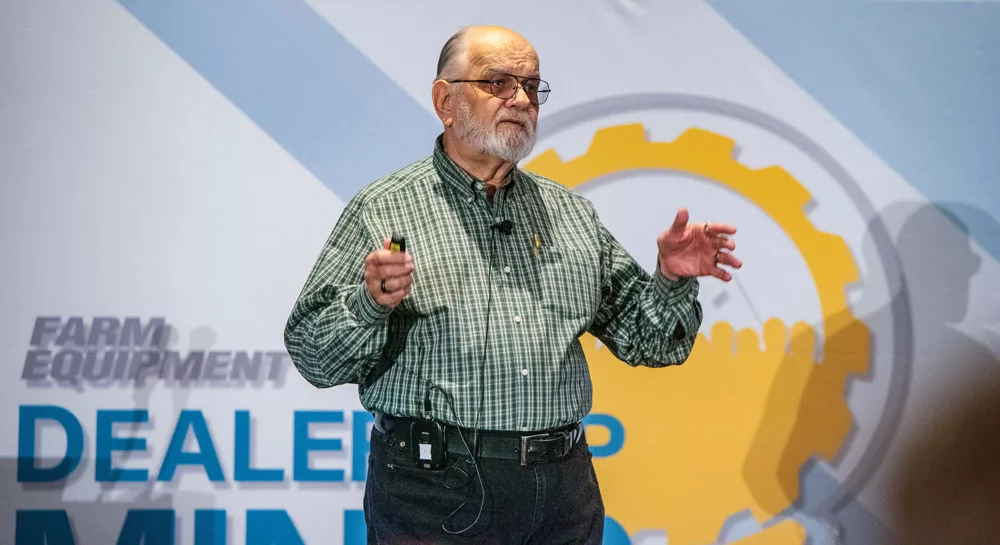
The following article is based on a workshop that took place at the Dealership Minds Summit in July 2025.
There’s a metric in dealership management that every leadership team should be focused on — absorption rate. When monitored religiously and managed strategically, your absorption rate can unlock the door to a more viable, prosperous future built on less risk and more opportunity.
“It’s pretty simple, high absorption equals financial stability,” says George Keen of Wise Wolf Consulting in Cape Coral, Fla.
Why Absorption is So Important
Absorption measures how well parts and service profit covers total dealership expenses. For example, if a dealership generated $102,000 in parts and service profit, along with $163,000 in total dealership expenses, the absorption rate is 63%.
According to Keen, 63% absorption is average for an auto dealer, but not very good for an equipment dealer. “Car dealers are able to put more profit to the bottom line from their car sales,” Keen says. “Ag dealerships can’t because they don’t achieve enough net profit from equipment sales.”
Given that reality, the average ag equipment dealer needs to see more profit dollars from parts and service, which is why Keen says an absorption rate of 85% or higher is ideal. The average in North America is around 71%. Not bad, but not enough if you want to be a high-performing dealership.
Higher absorption is important because it helps ensure expenses will be covered when equipment sales are slumping. That helps dealerships withstand economic downturns, as well as temporary shocks to demand like tariffs, interest rates, weather, weak commodity prices and weak farm incomes.
There’s a side benefit to not having to rely so much on equipment sales to keep the lights on.
Wise Wolf Consulting
“High absorption enables a more aggressive equipment sales strategy,” Keen says. “If you know your overhead is covered by parts and service profits, you can afford to offer better deals or financing on equipment.”
There have to be limits to that sales aggression, of course, because a sales team doesn’t want to be selling tractor after tractor at a loss. In fact, Keen says it is standard practice to remove sales department personnel expenses from total dealership expenses when calculating absorption rate. Why? Sales department staff should be able to support themselves through the sales they make. When they can, and parts and service dollars are covering all other expenses, another interesting thing can happen.
“Higher absorption allows the sales department to invest in additional personnel,” Keen says. “In fact, high-absorption dealerships tend to spend 17% more on sales department personnel. That can eventually lead to more sales, which leads to an expanding base of installed units that will demand more service and replacement parts in the future.”
One other adjustment to the absorption formula can include the addition of equipment rental profits to the top line. Not all ag equipment dealerships offer rentals. But for those that do, it makes sense to factor rental profits into absorption because, just like parts and service, rentals reduce the dealership’s reliance on equipment sales.
Here’s what the difference could look like for the typical $25 million dealer:
- FORMULA 1: Parts and service profits / total dealership expenses = 68.2% absorption
- FORMULA 2: Parts and service and rental profits / total dealership expenses - sales department personnel costs = 81.7% absorption
As you can see, the manner in which absorption is calculated can have a big impact on what the final absorption rate is. The main point is that a dealership needs to have a vision for what it’s trying to accomplish, and then measure and manage the numbers accordingly to achieve that vision.
“Higher absorption allows the sales department to invest in additional personnel. That can eventually lead to more sales, which leads to an expanding base of installed units that will demand more service & replacement parts in the future…”
“Achieving higher absorption goes beyond merely covering expenses,” Keen says. “It represents a strategic approach for the dealership to become its customers’ preferred supplier by fully understanding customer needs.”
Once this strategic mindset is adopted, Keen says dealerships stop relying on walk-in parts customers who only visit the dealership when equipment fails.
“Proactive dealers who focus on absorption employ aftermarket sales teams who actively engage with farmers and other clients in the field,” Keen says. “This approach fosters trust and collaboration because dealers seek innovative ways to support customer needs, whether through equipment sales, telemetric precision services, parts consignments or other creative solutions. Consequently, these dealerships become indispensable partners in their customers’ success.”
Key Drivers of Absorption
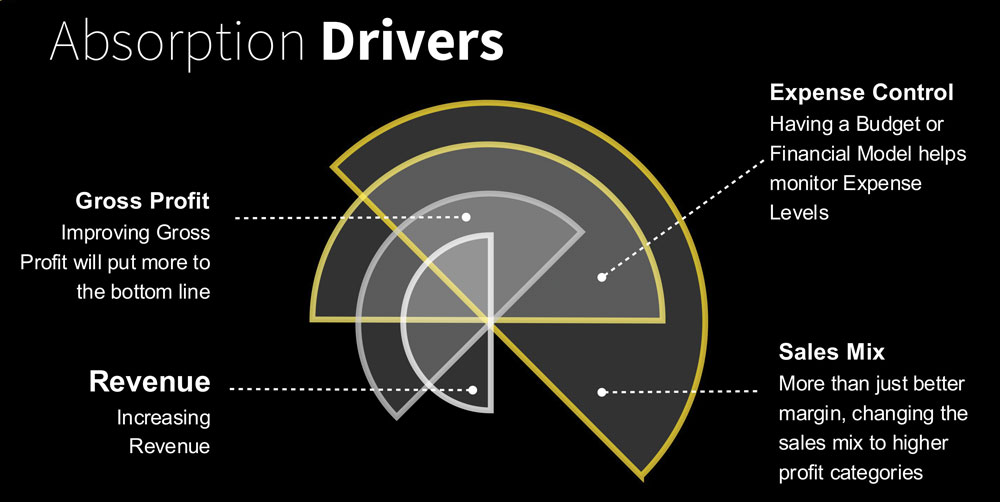
If a dealership decides it wants to improve its absorption rate, Keen says there are 4 drivers to build a strategy around.
Revenue Growth. The more parts, service and rental revenue a dealership brings in, the more money there is available to cover dealership expenses — assuming that the revenue growth isn’t being generated at a loss.
Gross Profit. Finding ways to increase gross profit also makes more money available to cover expenses. Sometimes it’s simply a matter of pricing, and other times it’s about things like inventory management, cost control, operational efficiency or marketing. Regardless, even something like a 3% increase in parts gross margin can make a huge impact on absorption rate.
Expense Control. Finding ways to intelligently cut costs helps reduce the amount of dealership expenses that parts, service and rental profits need to cover. Keen says it can be effective when department managers collaborate in this area.
“I worked with a dealer principal in California who sat with his managers for 2 days looking at the dealership’s financials on a big screen,” Keen tells. “They went department by department, line item by line item. The parts manager was asking the rental manager questions, and vice versa. They challenged each other on everything, right down to small expense items like shop rags. They looked at the vendors they were using … every possible way to try and trim expenses.”
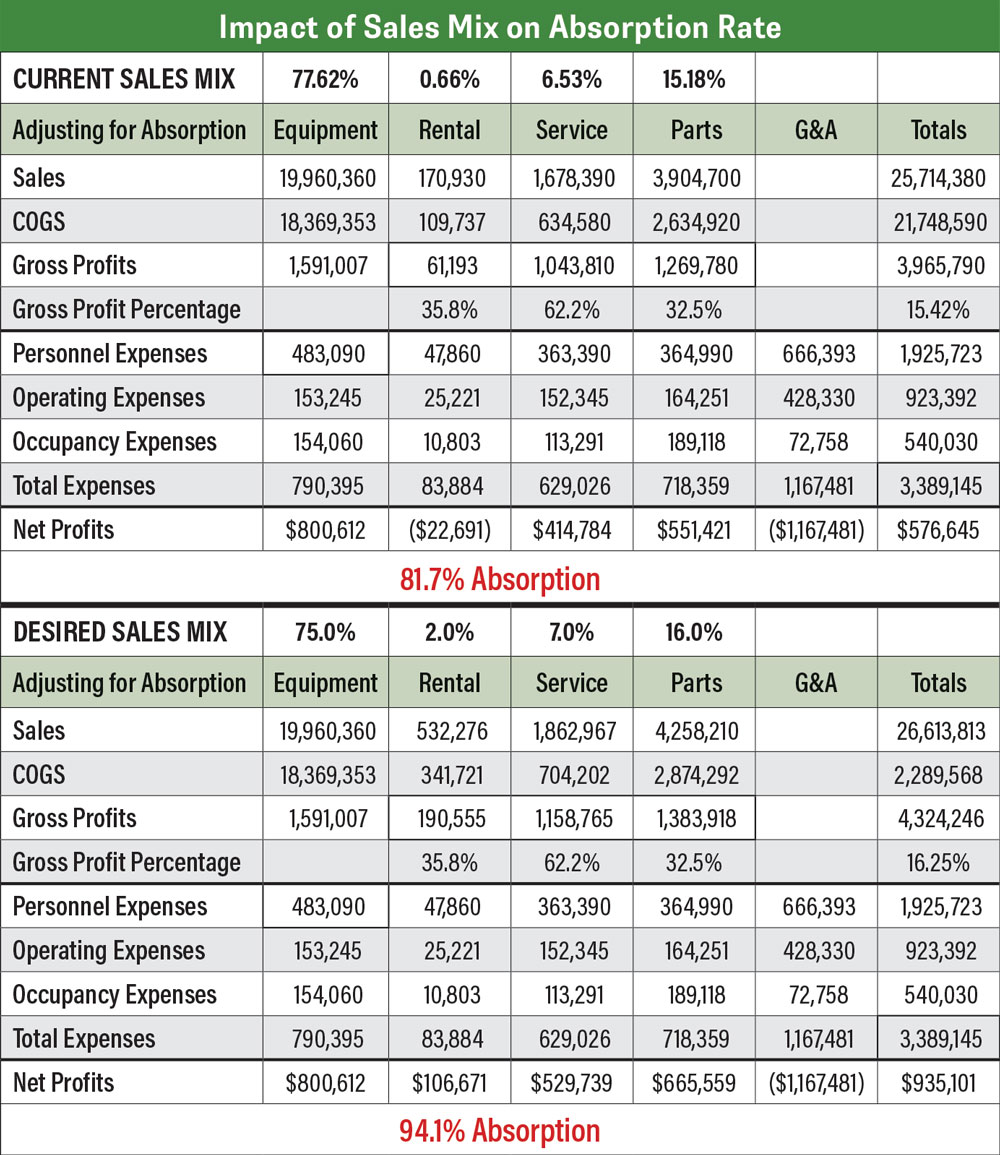
Of the 4 key drivers of absorption, shifting sales mix toward aftermarket will typically produce the best gains. Please note that, in this example, rental profits are being included in the absorption formula while equipment personnel expenses are being removed. Then, equipment sales are holding steady, rental revenue is tripling, and parts and service revenue are each increasing modestly by less than 1%. Dealership expenses are holding steady. As you can see, even a subtle 3.4% sales mix shift to aftermarket has a profound impact on absorption.
Sales Mix. Even if a dealership isn’t growing as a whole, shifting revenue in the direction of higher-profit parts, service and rentals will help increase absorption. Keen says this part of the absorption-improvement strategy will often yield the biggest gains.
“You don’t have to jump off a cliff to make huge changes either,” Keen says. For example, the typical $25 million dealer could improve absorption by 5%, simply by going from 0.7% to 2% on rental equipment, 6.5% to 7% on service, and 15% to 16% on parts. “The more shift a dealer can make to aftermarket revenue, the stronger their absorption will be,” he says.
Shifting sales mix doesn’t mean a dealership tries to limit the amount of equipment it can sell. Rather, the dealership begins making a prioritized effort to increase aftermarket revenue, which may require staffing changes and a different kind of relationship with customers. This is true for large and small dealers alike.
“Achieving absorption isn’t about the size of the dealership,” Keen says. “It’s about management focus and achieving the right sales mix. Simply getting bigger doesn’t guarantee reaching high absorption. High absorption requires a strategic approach.”
Barriers to Higher Absorption
Part of a dealer’s strategic approach involves breaking down the barriers to high absorption. Given the 4 key drivers of absorption described above, Keen says the following can often get in the way.
Underutilized Service Capacity. When trying to drive service revenue and profits, Keen says dealers must track shop labor hours closely. “It doesn’t matter if you use dealer software, an Excel spreadsheet or a piece of paper,” Keen says. “You have to know how productive technicians are being and what you are billing.”
Keen says keys to overcoming this barrier include:
- making sure there’s enough service work coming in the door
- effective scheduling
- finding ways to improve efficiency and reduce technician wasted time
- establishing productivity goals
- sharing data with techs so they know where they stand and remain motivated
Insufficient Parts Sales. According to Keen, too many dealers rely on over-the-counter parts sales. Too many dealers have sub-90% fill rates. Parts department staff must feel compelled to do better.
“You’re not going to get there unless you’re using a computer system to track your history and determine your inventory based on actual demand,” Keen says. “In the process, are you working on marketing parts to your customers and prospects? Can you sell online? And if you happen to be a red dealer, are you still marketing to green customers, or vice versa? Just because a farmer bought another color of equipment doesn’t mean they can’t become your customer.”
High Operating Costs. Inefficiencies and excessive fixed expenses make high absorption rates harder to attain. As described earlier, dealership leaders should sit down with staff to identify ways to improve. It’s also important to establish reasonable benchmarks so you know what you’re striving for.
Lack of Focus. This may be the biggest barrier of them all. “You have to outline a vision for what you’re trying to do,” Keen says. “You also need the right metrics to help you get there. Once you have your metrics, scorecards and financial reports, etc., you have to take the time to analyze them. Work with your team on them. Here’s where we are, and this is what we need to do to get where we want to go.”
In working the strategy to increase absorption, Keen says it’s important to regularly solicit feedback from managers and staff. What changes have been implemented? Has there been any impact? Do we need to do something differently?
On that note, Keen says the real secret is gaining and maintaining executive commitment. If the people holding the purse strings don’t understand the importance of what you’re doing, you’ll never get the lasting support and resources required to make it work. At the same time, if employees can’t see that leadership is engaged, their own inspiration may start to fizzle out.
“If a dealership is going to focus on absorption and becoming a high-profit dealer, the commitment has to be consistent,” Keen says. “The industry is going to continue to evolve. Absorption is part of sustaining financial strength in your dealership, whether you’re a $2 million dealer or a $200 million dealer.”
CASE STUDY: How One Profit-Strained Dealer Set a Strategy for 80% Absorption
George Keen’s 2025 Dealership Minds Summit workshop included an exercise where attendees studied a fictitious dealership’s financial position, and suggested various tactics that could help improve its absorption rate. Following are some of the ideas that came out of that session.
Background on the Business
The fictitious Smithfield Equipment is a single-location dealership in business for 15 years. Annual sales are roughly $20 million. Because the dealership is heavily reliant on equipment sales, senior management is concerned that the business could be incapable of withstanding the cyclical nature of the ag economy. Profitability has already been under pressure.
Market Dynamics — Roughly 250 farming operations in their area. Equipment sales boomed 5 years ago, but have remained cool since. Farmers are keeping equipment longer. Competition is intense.
Service Department — 8 technicians are operating at 74% capacity. Posted labor rate is $125, but the effective labor rate has been $106. Service work slows down significantly over the winter months.
Parts Department — $2.6 million inventory. Fill rate is 85%. Obsolete inventory is higher than desired at 9.7%. Gross margin is 32.5%. Almost all sales are through the service department and to walk-in customers.
Equipment Sales — Sold 155 new machines last year and 57 used. New equipment margins are just 7%. Used equipment is better at 15.5%. Sales commissions and floorplan expenses are high.
Rental Department — Currently a small piece of the sales mix at 0.66%, generating roughly $171,000 in revenue at a 36% gross margin. The problem is that expenses exceed gross profit by more than $20,000.
Expenses — $3.4 million total, $1.2 of which are fixed admin costs. Building lease and utilities are high at $540,000 due to the size of the building. Sales department expenses are $1 million. Parts and service department expenses are roughly $1.5 million.
What Tactics Could Help Increase Absorption?
Increase Service Revenue. Developing a winter service program could help drive shop revenue during the slower months. Doing so will also boost technician productivity, which is currently lower than the benchmark of 85%.
Increase Service Profit. As a result of the above revenue-driving tactics, dealership profitability should improve due to sales mix shifting more toward service. Additionally, the posted labor rate should be revisited, as it could be low relative to other dealers in the area. Even more importantly, the effective labor rate is far too low. The service manager should investigate if repair work is being quoted correctly, where there could be bottlenecks and inefficiencies in the shop, and if there is an issue with open or unbilled work orders.
Increase Parts Revenue. Since the dealership is serving a sizable customer base with a lot of equipment that is at least 5 years old, a more aggressive parts marketing strategy should be implemented. Tactics could include phone, email and direct mail marketing to existing customers, along with the development of an online parts store and/or selling via online marketplaces.
Increase Parts Profit. Parts pricing should be analyzed in an effort to increase margin from 32.5% to 35.0%. A clear process for returning or discounting obsolete parts should also be developed. Using a parts pricing matrix could improve margin without obvious price increases.
Reevaluate the Rental Department. The rental department is losing money. Leadership should investigate a strategy to improve utilization and make rentals a more meaningful segment of the business. “Frequently, the problem is that pickup and delivery transportation is not being charged to the customer,” Keen points out.
Reduce Expenses. Because they operate in such a large building, occupancy costs are high. Leadership should go through the expense budget line by line to search for ways to reduce those costs. Heat and electricity are often areas where numerous subtle changes can have a meaningful impact. Leadership should also reevaluate how the building is laid out and being used in order to ensure that wasted space is minimized. Then, it may also be worth exploring if any unneeded space could be rented to other businesses or perhaps consumers looking for storage space to help generate additional revenue to offset the high occupancy expenses.
Attendees of Keen’s workshop were also presented with more detailed financial information regarding each of Smithfield Equipment’s departments. One attendee recognized a major shortfall in vehicle/delivery expense recovery across the service, parts and rental departments. Leadership should investigate that, and put processes in place to make sure these costs are being billed correctly so they can be fully recovered.
These are just a few of the many ideas that came out of the workshop. In closing, Keen left attendees with perhaps the best idea of the them all.
“When it comes to increasing absorption, sometimes the biggest problem is our inability to make a decision and move forward,” Keen relates. “That’s why having a clear vision, interdepartmental collaboration, and a commitment from leadership are so important.”