In this episode of On the Record, brought to you by Associated Equipment Distributors, we report on Yetter Manufacturing’s acquisition of Martin Industries. In the Technology Corner, Noah Newman stops by the PTx booth for a first look at Precision Planting's new ArrowTube. Also in this episode, clarification on what the EPA’s guidance on the Clean Air Act means for right to repair and a preview of Rural Lifestyle Dealer’s Dealer Business Trends & Outlook report.
.png)
This episode of On the Record is brought to you by Associated Equipment Distributors — the leading association in North America for the equipment distribution industry.
Get ready for a powerful start to the year with AED’s packed lineup of Q1 and Q2 events designed to connect, educate, and energize industry professionals. From high-impact conferences and hands-on training sessions to exclusive member gatherings and strategic leadership programs, AED is bringing together top experts and forward-thinking dealers to share insights that drive growth. Whether you’re looking to sharpen your team’s skills, stay ahead of emerging trends, or expand your network, our first-half-of-the-year events deliver unmatched opportunities to elevate your business and strengthen your competitive edge. Visit www.aednet.org/ for more information.
TRANSCRIPT
Jump to a section or scroll for the full episode...
- Yetter Manufacturing to Acquire Martin Industries
- Dealers on the Move
- Precision Planting Showcases ArrowTube at National Farm Machinery Show
- Tracking Crop Prices
- ‘Nothing’s Changed’ with EPA Guidance on R2R, Emissions Controls
- Dealers Forecasting Revenue Growth for Rural Lifestyle Segment
Yetter Manufacturing to Acquire Martin Industries
Western Illinois-based Yetter Manufacturing and Kentucky-based Martin Industries announced to dealers last week Yetter’s intent to acquire Martin, with a deal expected to close this quarter.
The acquisition, say the two ag equipment manufacturers, brings synergy from their companies’ common mission of bringing innovations to the market that improve efficiency and profitability.
Both companies grew from humble, deep roots in business, family, and innovation. Yetter has been family-owned and operated for 95 years while Martin was founded 34 years ago and led by the father son-duo of the late Howard Martin and son Steve. Both companies were profiled in the special of the How We Did It docuseries from the editors of Farm Equipment.
We checked in with Tyler Thomas from Yetter down here in Louisville.
The move combines decades of expertise, engineering excellence, and farmer-focused innovation. Yetter and Martin Industries will continue to deliver their lineup of planter attachments, fertilizer equipment, closing wheels, and more, designed to meet the evolving challenges of modern agriculture."Here just this last week, we just had a public announcement that Yetter had acquired Martin Industries. Obviously, two family, homegrown, down-to-the-earth, roots company coming together. Still going to be operating independently. But yeah, we're really excited, the growth potential, the different projects we're going to be able to work on through both companies. Still operating independently on their own, obviously. But yeah, we're very excited for it."
We’ll have more on the acquisition in the coming weeks.
Dealers on the Move
This week’s Dealer on the Move is Johnson Tractor. The Case IH dealer has acquired Farmers’ Implement, adding 2 stores in Allenton and Columbus, Wis. The acquisition is effective June 1.
Precision Planting Showcases ArrowTube at National Farm Machinery Show
Maximizing inputs was a big theme at the National Farm Machinery Show, which bodes well for the precision technology world in 2026. There was plenty of cutting-edge tech on display in Louisville. We got our first look at Precision Planting’s ArrowTube. Let’s check out out how it works.
"The ultimate goal of ArrowTube would be to orient seeds, trying to stick them tip down in the furrow for better, more consistent emergence. It's an amazing piece of technology that mates up with the vSet meter, using basically a seed accelerator to help orientate the seeds using some frictional forces up here at the top, sliding it down this twisted C tube here to try to use some centrifugal forces as well, while a knife is kind of slicing almost like a sub-furrow in the ground, giving just a very little trench inside the furrow for that seed to land tip down inside of it."
"This is the ultimate goal would be tip down like this. You can see with our seed here, it'll highlight it green. Where we're actually using a camera at the base of it here just to show, so we can see on the screen here how these seeds are landing. The strong majority of them will be tip down as they land into the ground, into that furrow. It is also a high speed system, so not only are we able to orientate the seeds as they come out, but we're spacing very well."
ArrowTube is going through another round of testing this spring, and could be available for some farmers later this year.
Tracking Crop Prices
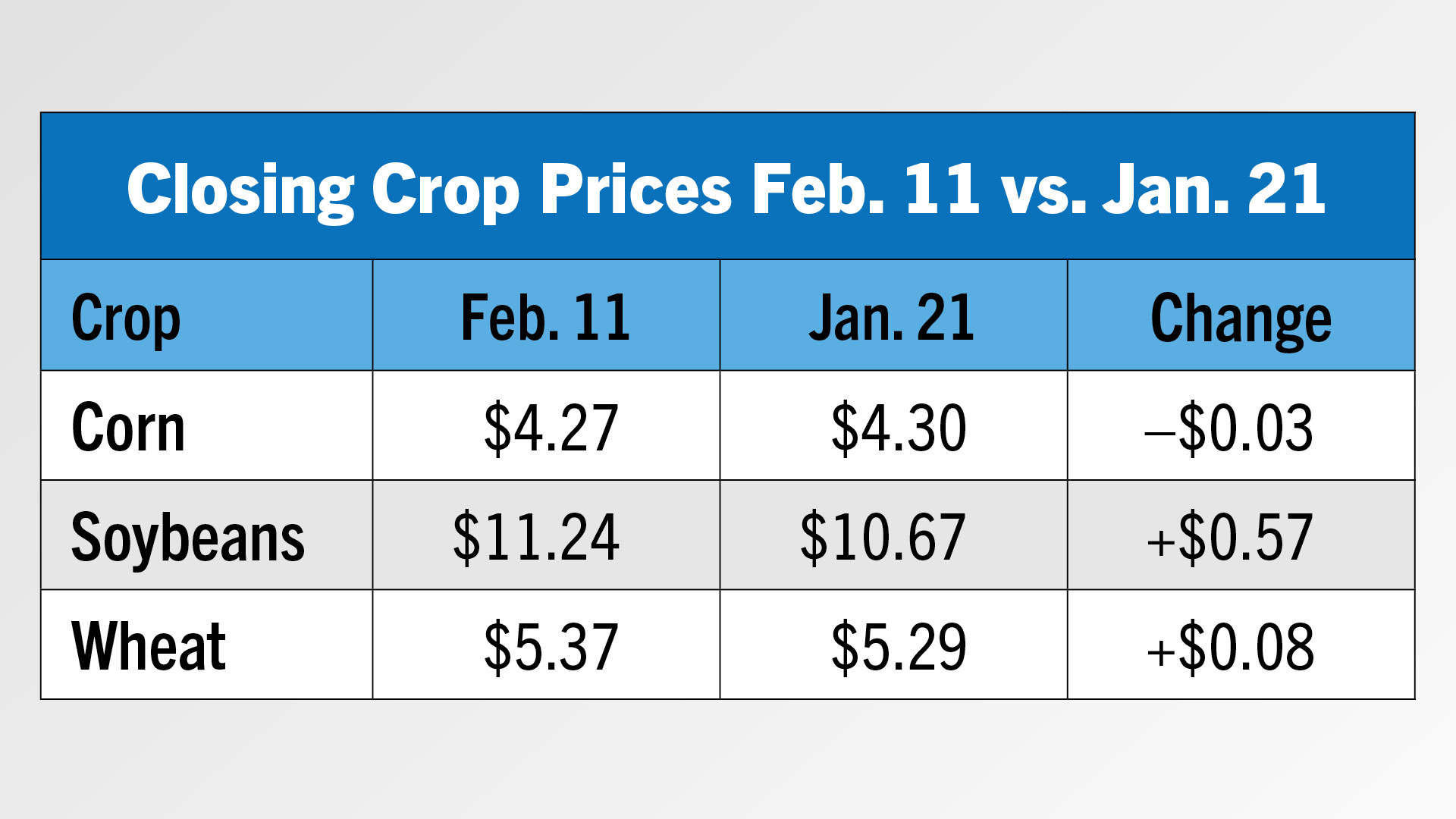
As of February 11, corn prices were $4.27, down 3 cents from our last episode. Soybeans closed at $11.24, up 57 cents. And wheat closed at $5.37, up 08 cents.
‘Nothing’s Changed’ with EPA Guidance on R2R, Emissions Controls
On Feb. 2, 2026, the United States Environmental Protection Agency issued guidance reaffirming existing policies that temporarily disabling aspects of an emission control system or components to repair or maintain a nonroad engine is permissible under the Clean Air Act (CAA).
While the EPA’s press release included rhetoric that made it sound like the guidance was changing the game, Brian McGuire, president and CEO of Associated Equipment Distributors, and Daniel Fisher, senior vice president of government affairs, say that the guidance — when you dig down into it — affirms the equipment industry’s stance on right to repair. That is, farmers can repair their equipment but cannot modify it.
The release from EPA stated:
For years, prominent equipment manufacturers have interpreted the CAA’s emission control anti-tampering provisions as preventing them from making essential repair tools available to all Americans. This has forced farmers to take their equipment exclusively to manufacturer-authorized dealers to be fixed, even though the repair could have been made in the field or at a nearby independent repair shop. Not only has this made repairs more costly, but it has also caused many farmers to opt for older agricultural equipment that lack modern emission controls simply because they can fix that equipment themselves.
Here is what McGuire and Fisher had to say, which helps clarify the EPA’s statements.
Daniel Fisher: "Really, ultimately, what the guidance did was really reaffirm what AED's position has been all along, that customers have the right to repair their equipment, and if you need to disable the emission systems temporarily to repair it, that's fine, as long as you return it back to compliance with the Clean Air Act. That's essentially what the guidance says, and that's been AED's long time position on this issue."
Brian McGuire: "Yeah. Yeah, so really no change, Kim. Really a clarification of what already existed."
Daniel Fisher: "The Clean Air Act still exists in it's current form and it still would be considered illegal."
Brian McGuire: "That's the reason we issued our statement so that folks understood that there's not a change here. I know that there was some chatter that, oh, we can disable the systems, DEF no longer means anything, and that is absolutely not the case, currently."
Kim Schmidt: "Okay. Anything dealers need to know specifically for how to communicate that to any customers that it comes up with them?"
Brian McGuire: "Yeah, I think the easiest thing for a dealer is just to let the customer know that really nothing has changed. It's probably easiest to say that the EPA just clarified the existing position when you get to the meat of the document they issued after you get through the press release."
Kim Schmidt: "Okay. Okay."
Brian McGuire: "Danny, would you agree with that?"
Daniel Fisher: "No, absolutely. I think, again, our position... generally our dealer's position has been that customers have the right to repair their equipment, and this certainly sustain that position."
Dealers Forecasting Revenue Growth for Rural Lifestyle Segment
Following a year in which revenues turned out to be better than they had forecast, dealers are largely positive in their outlook for revenue growth from the rural lifestyle market, according to the 2026 Dealer Business Trends & Outlook survey. According to the survey, over 90% of dealers are forecasting their wholegoods revenues to be as good or better than in 2025. Tillers, chainsaws and power hand tools top the list of dealers’ best bets for improving unit sales in 2026.
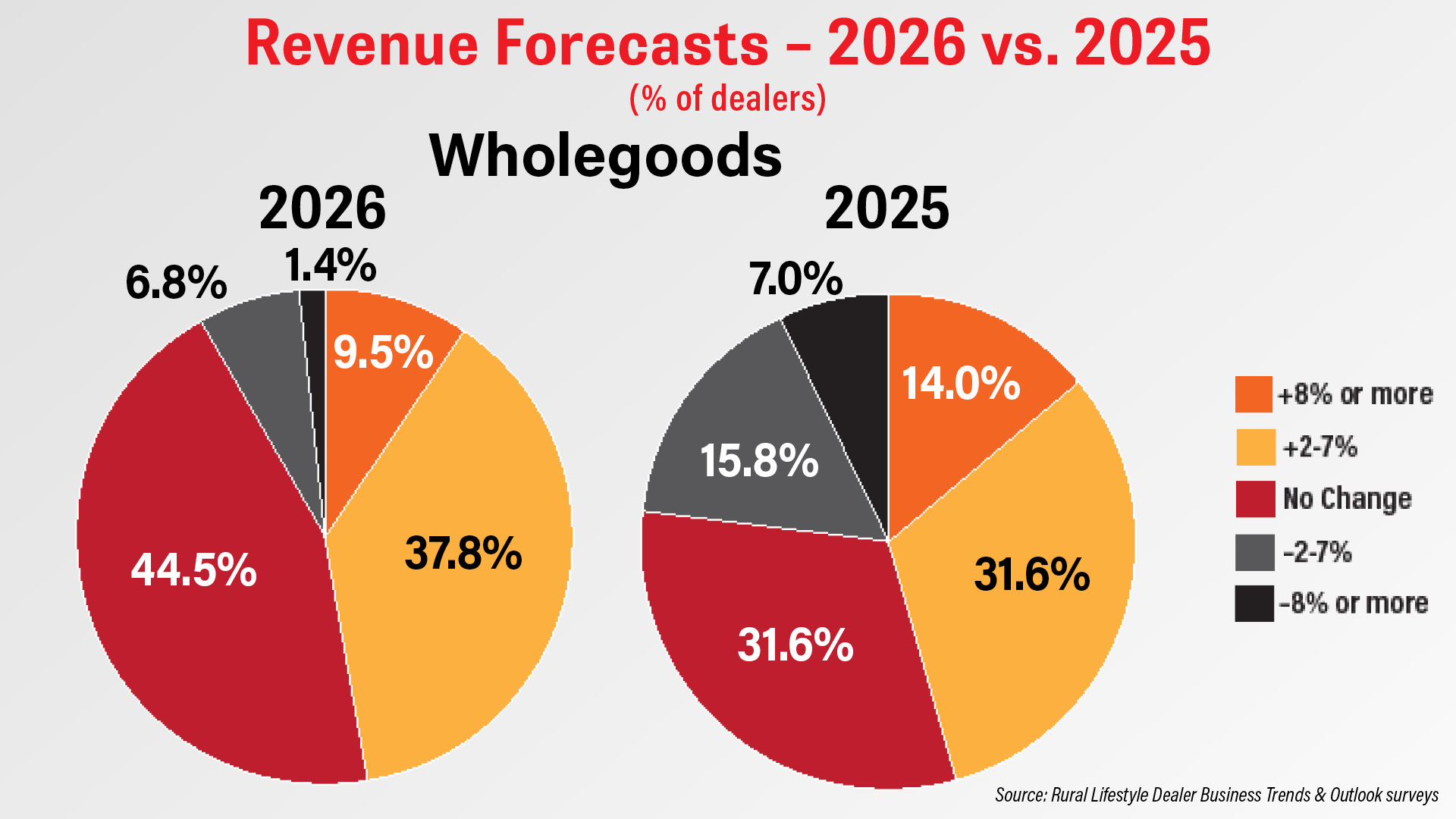
Compared to their forecasts for 2025 revenues, dealers reported better results overall. In their outlook ahead of 2025, 75.8% of dealers were calling for revenues to be as good or better compared to 2024. As 2025 drew to a close, 81.3% reported their total revenues were as good or better than 2024. The percentage of dealers who said their revenues were roughly flat improved by 6.7 percentage points compared to the 2025 forecast.
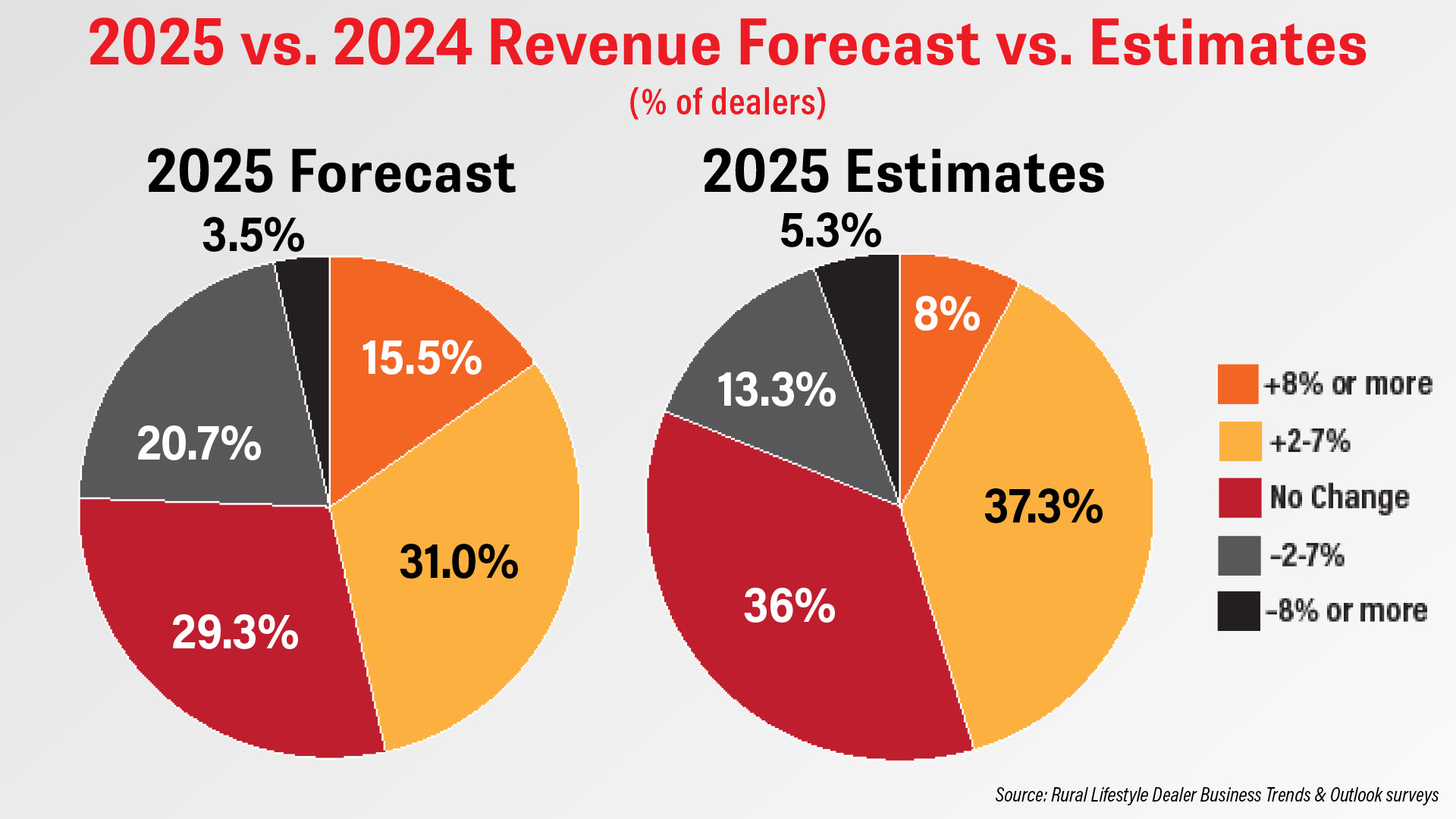
Just over 37% of dealers reported 2025 revenues were up 2-7% over 2024, up 6.3 points from the percent who forecast that level of growth a year ago. Fewer dealers reported their total revenue was up 8% or more than had forecast that level of growth a year ago — 8.0% vs. 15.5%.
On the Record is now available as a podcast! We encourage you to subscribe in iTunes, the Google Play Store, Soundcloud, Stitcher Radio and TuneIn Radio. Or if you have another app you use for listening to podcasts, let us know and we’ll make an effort to get it listed there as well.
We’re interested in getting your feedback. Please feel free to send along any suggestions or story ideas. You can send comments to kschmidt@lessitermedia.com.