
As growers prepare to head into harvest, grain bagging equipment is heading into a hot market.
“By mid-July, we were selling baggers faster than we could make them,” says Shannon McComas, vice president of sales and marketing for Loftness. “Grain baggers are traditionally a cyclical product — you’ll sell a few here and there, but then the conditions all come together when everyone wants them — we’re in one of those cycles right now.”
A big driving force behind the current cycle is the corn crop. The USDA is projecting another record-setting harvest this year.
“When grain prices are low, you start hearing a lot more talk about bagging,” says Jerry Hanson, sales manager at Busch Equipment in Columbus, Neb., the U.S. distributor for the Akron brand. “Elevators are full and there’s a lot of grain sitting in bins all over the country. Farmers need a place for this year’s harvest to go, and there just aren’t many good options.”
One good option, however, is to bag their own grain. This gives farmers an efficient and reliable storage option that also allows them to market their grain at a time when pricing is more favorable.
“Then growers can play not only the elevators, but also customer segments like feed lots, the export market and ethanol and biodiesel plants,” Hanson says.
Grain bagging equipment can also help keep field production humming along at a time of year when productivity matters most. In fact, Hanson believes the “cost of poor production” is often the biggest motivator for growers to invest in grain bagging equipment — and that’s a perennial thing.
“When the trade-in combine’s running over $400 an hour, farmers can’t afford to let their combines sit in the field idling while they’re waiting for trucks to haul their crop to the bins or elevators,” Hanson says.
Grain bagging equipment also comes in handy when there’s a big harvest. Hanson says he knows of many growers who pull out their grain bagging equipment after their on-site bins fill up, helping ensure that no income is left in the ground.
Equipping Farmers
According to Hanson, Busch Equipment’s best Akron dealers are in regular contact with local growers throughout the year to gauge their need for a little extra help come fall harvest.
Growers can also look to the USDA for financial assistance, which also makes it easier for a dealer to close some sales. “Grain bagging is now part of the storage program,” Hanson points out. “Farmers can take out low-interest loans on bagging equipment and bags.” Farmers are encouraged to visit Farmers.gov/loans or visit their local USDA Service Center to learn about what’s available.
According to Hanson, a base grain bagging system will run upwards of $90,000. The 2 essential elements are a grain bag loader and a grain bag unloader. The loader ingests grain being fed from the grain cart and packs it into a huge bag, while the unloader extracts the grain from the bag and augers it into a truck when a grower’s ready to sell it. That’s why Hanson likes to refer to the unloader as an extractor.
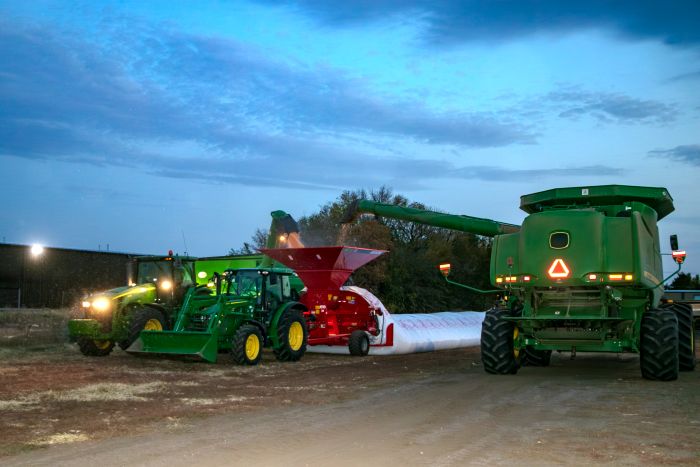
The Akron GTT5010 Grain Bagger is a 10-foot bagger with a large 8.5’ x 11’ hopper for easier grain loading. Source: Busch Equipment, the U.S. distributor for Akron
Grain bagging equipment is designed to work with a grower’s existing harvesting equipment, including combines, grain carts and hopper trailers. “I’ve watched grain carts and semi-trucks unload into one bagger at the same time. They can’t unload fast enough to overwhelm it,” McComas relates.
Speaking of trucks, Loftness also offers an optional truck-unloader for transferring grain from a truck into a bagger. Another optional piece of equipment is a bag baler, which Loftness also offers. A bag baler hydraulically pulls an emptied, rolled-up bag off of the grain bag unloader, placing it in a bale with a wrapper and ties. Then the grower can haul it away later with pallet forks.
“It typically takes 2 or 3 workers to physically remove those empty plastic bags from the unloader, roll them out and fold them back up for easier disposal,” McComas says. “The grower needs to think about how many grain bags they’re going to handle over several years and figure out what it will cost to pay 2 or 3 guys to do it manually. Then the cost of a bag baler might start to sound pretty attractive.”
How Dealers Can Start Bagging Grain Bagger Sales
Like with most farm equipment, convincing a farmer to invest comes down to explaining the ROI. There are a few key factors with grain bagging equipment.
Cheaper than building bins. “When you’re bagging, the cost of storage is pennies per bushel,” McComas says. “When you’re building permanent storage, you’re talking dollars per bushel. Furthermore, when a farmer is renting ground, their bagging equipment goes with them if they leave.”
Loftness dealer Craig Fisher agrees. “It’s pretty hard for the typical farmer to borrow money and build their own bins — especially when they can’t be certain if they’ll be farming that land in 5 years,” says Fisher, owner of Antelope Farm & Ranch Supply in Richardton, N.D.
Speed up harvest. As Hanson touched on earlier, gaining the ability to keep combines moving is a big benefit of grain bagging. The faster farmers can get their crops off, the better.
Fisher adds to that by offering the following hypothetical scenario.
“Say you’re doing some big acreage and your 4 custom combines come in, which together with yours gives you 8,” Fisher says. “Each combine can do 200 acres a day, so you’re looking to take 1,600 to maybe 2,000 acres off in a day. At 50 bushels, the amount of grain you can pull off in a day is absolutely huge. But the number of trucks, grain carts and bins you need creates a horrible bottleneck. On the other hand, one 12- or even 10-foot bagger will keep you ahead of those combines all day long. So, for me, the biggest reason to get into grain bagging has to do with logistics, plain and simple.”
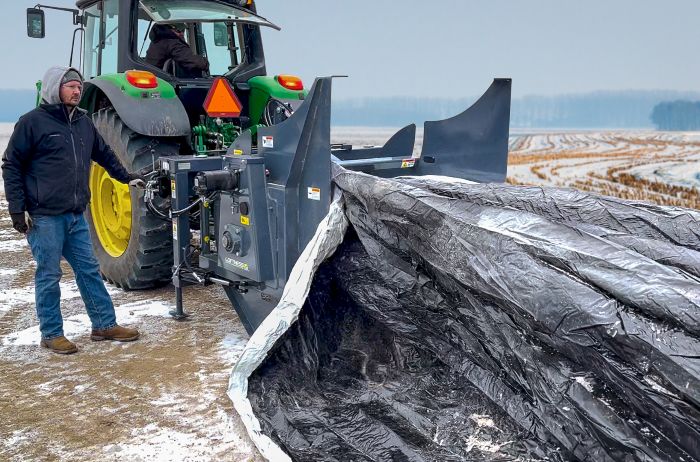
Grain bag balers can be a useful addition to a grain bagging system. Source: Loftness
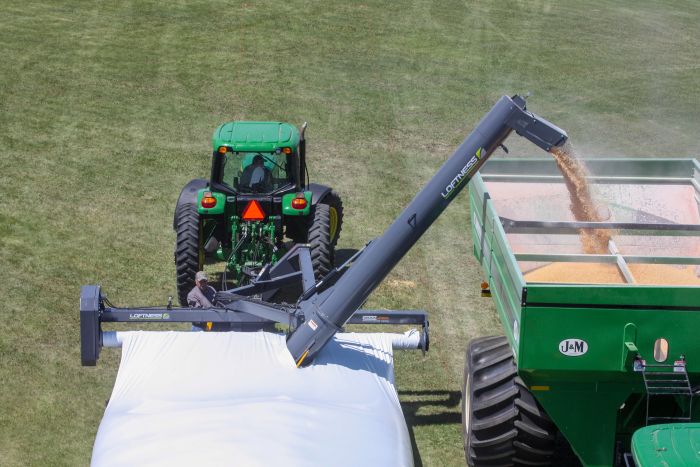
Loftness offers 10- and 12-foot grain bag unloaders designed for fast setup and operation. Source: Loftness
Setting up growers for success. Growers do need to think about what equipment size makes the most sense for their operation. Generally speaking, 10- and 12-foot models tend to be the most popular, though some companies offer models in the 9-foot range.
Fisher says many of his customers prefer a 10-foot bagger because it’s easier to transport down the road, yet is capable of handling 500-foot-long bags for maximum productivity.
“A 10’ x 500’ bag holds around 22,000 bushels of wheat,” says Fisher, who also farms 15,000 acres in addition to being a Loftness dealer. “But if you want even more productivity, a 12’ x 500’ bag will hold 32,000 bushels. The 12-footers are also built more industrial-like. I personally have run more than 25 million bushels through mine.”
Speaking of industrial-like design, McComas says that’s a hallmark of Loftness grain bagging equipment. Fisher agrees, adding, “Just look at the flighting and overall structure of a Loftness bagger. These things can last a really long time and do an incredible amount of bagging.”
Another helpful feature of Loftness grain bag loaders is the combination of transport wheels and bagger wheels. As McComas explains, bagger wheels have a brake system that helps operators optimize bag filling. Those bagger wheels can be raised up when transporting the loader from field to field, helping reduce wear and tear on the bagger wheels’ brake system.
There is a bit of a learning curve to using grain bagging equipment. To that point, dealers should tout features that make bagging easier.
“Take a look at how easy it is to put a bag on a loader,” Hanson advises. “Akron, for instance, has two unique features, a Hydraulic Extendable Pan and an Easy Lift cradle, that help eliminate a lot of the lifting an operator needs to do. Akron grain loaders also have really big hoppers that make it easier to load grain and keep the grain cart moving efficiently.”
When it comes down to it, efficiency and productivity are what make grain bagging a good option for growers — especially during abundant harvests. Having the ability to store their grain to sell at a later time when prices are better is equally enticing.
But is storing grain in bags actually reliable? “It all depends on the moisture level, but a farmer can confidently store his crop anywhere from a couple of months to a year, if not a little longer,” Hanson says.