
Dr. Jim Weber, veteran consultant in the farm and construction equipment industry, identifies territory assignment as a core tactical activity that increases wholegood sales. Rather than treating sales territories as geographical boundaries or a route for sales reps to drive around, Weber presents a mathematical approach to defining, segmenting and staffing territories based on market data, customer value and call capacity math.
“I don’t care if the territories are geographical. I don’t care how they are,” he says. “But we have to assign the territory. We have to have territories for these individuals.”
By replacing guesswork with real data, dealership leaders can transform sales reps from passive into proactive people who manage their assigned market potential.
The Trade Area Formula
The foundation of Weber’s territory model is built on calculating the market size within a dealership’s geographical boundaries. The manager must compute the geometric trade area, which is dictated by neighboring competitive locations.
Using a real-world scenario from a New Holland location in Wooster, Ohio, Weber demonstrates the trade area calculation step-by-step.
Before the calculation begins, Weber sees how far neighboring same-brand dealerships are from the location. In this scenario, the closest New Holland dealerships are 30 miles east, 25 miles west, 40 miles southwest, 35 miles southeast and 30 miles northwest. This totals 5 competing locations. Furthermore, it was assumed that 85% of the area is farmland, and the average size of farms in Wooster is 250 acres.
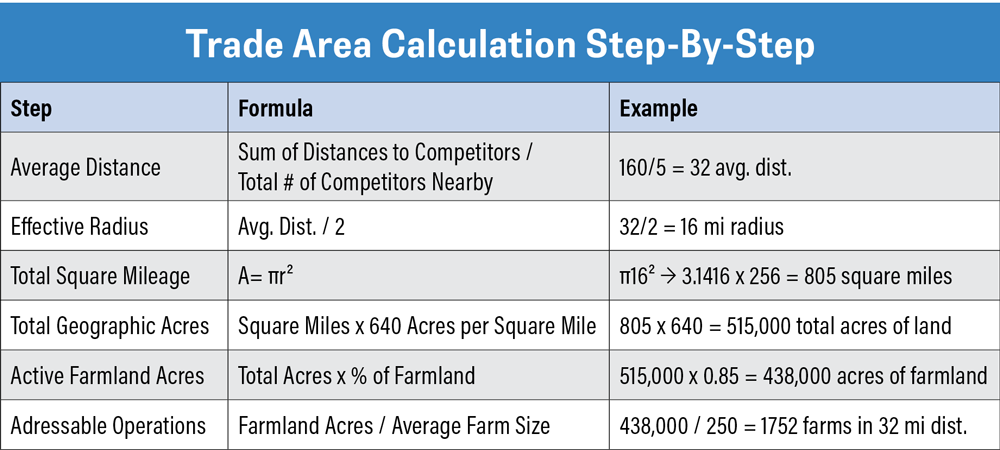
This step-by-step calculation estimates the number of farms within a dealership's local service area. Using the Wooster dealership as an example, there are 1,752 farms within a 16-mile radius.
Territory Segmentations: Weber’s Law of Halves
Once the total population of farm operations in a territory is calculated, dealerships must segment these accounts to prioritize sales. Still using the New Holland dealership as an example, Weber introduces the “Weber Law of Halves” to tier accounts into 5 categories:
-
Suspects (1,752): The total farm population in the territory.
-
Prospects (875): Commercial machinery buyers (roughly 50% of total suspects after filtering out non-purchasing operations)
-
Accounts (438): Operations that occasionally buy from the dealership.
-
Customers (220): Regular machinery purchasers
-
Partners / Key Accounts (110): High-value, repeat accounts that buy almost exclusively from the dealerships.
This account segmentation should be done over a 3-5 year period, Weber says.
Aligning Territory Size with Sales Force Call Capacity
A big fault within normal territory design is assigning massive geographic regions to reps without comparing the total territory accounts to actual rep call capacity.
Weber notes that high-performing field marketers make 25-35 sales calls per week across 46-48 working weeks per year, generating between 1,150 and 1,600 annual calls per rep. In contrast, low-performing sales personnel, or order-takers, average only 10-15 calls per week, with very few going to new prospects.
“There is no way I would accept somebody giving me less than 25 calls a week. None. Period. End of the story,”Weber says.
During this process, sales managers often realize they are understaffed or that sales reps are using their call capacity on low-value visits, Weber says.
Using the Ohio New Holland dealer as an example, if the dealership assigns 50 calls per year to each of its 110 key customers (once a week), that alone consumes 5,500 calls.
“We’re going to need more salesmen than the 5 you have. We’ll never get down to the prospects if I’m making 50 calls on those individuals,” he says.
50 calls per year is above what Weber suggests, and he proposes making a minimum of 12-24 calls on partners, preserving rep capacity to target prospects.
Economically Justifiable Call Allocation
To make sure territory visits remain profitable,Weber introduces rules for call allocation based on expected gross margin dollars and rep income goals.
-
Required Gross Margin per Call: If a sales rep aims to earn $100,000 annually on a 25% gross margin commission working 46 weeks at 25 calls per week (1,150 calls total), every single sales call must generate $348 in required gross margin dollars.
-
Justifiable Calls per Account: Dividing an account’s anticipated annual gross margin dollars by the $348 required margin per call determines the max number of visits that account can economically justify.
“Calculate the number of justifiable sales calls on a customer projected to purchase a $200,000 tractor with an anticipated gross margin of 5%,” Weber says. “Take the $10,000 (5%), and divide it by $348. That is 28.74 calls. He can economically justify making 28 calls a year on that individual.”
If an account generates $20,000 in gross margin, justifying up to 58 calls, but the rep only needs to visit 24 times (bi-weekly) the remaining 34 calls must be reallocated on high-probability prospects.
“This is math,” Weber says. “You’re not going to see this in any other sales training program. They’re not soft skills. This is probability.”
Leadership in Territory Management
Assigning sales territories through this method can help to transform sales management from passive supervision into active leadership. By combining geographic trade area math, account territories and call capacity calculations, equipment dealerships eliminate territorial overlap, ensure complete market coverage and maximize profit return on sales rep time.
“Accept the challenge so you can feel the exhilaration of victory,” Weber concludes. “It is about looking in the mirror and saying ‘I’m going to step up. I’m going to manage this business the way I should be managing. I’m going to manage it as a leader, not as a manager, but as a leader.’”
View More
Watch Dr. Jim Weber's full presentation at the 2019 Dealership Minds Summit here.