Takeaways
- Adding parts storage for overnight deliveries will protect expensive parts and improve efficiency.
- Have ways to track service truck locations so manpower and time is used efficiently.
- Come up with a plan to deal with the Right to Repair issue before touchy situations emerge.
As the hours of sunlight get shorter each day, combines are rolling across southern Nebraska for corn harvest — a potentially bumper crop for 2025 if government estimates are on track.
This means even more pressure for dealerships in farm towns like Titan Machinery’s store in Holdrege. The mantra of keeping customers going isn’t just a goal written on scratch paper: it’s vitally important to customers’ livelihoods.
The market value of products sold per farm in Phelps County, where Holdrege is located, rose 61% between the 2017 and 2022 Census of Agriculture — the figure placing the county 6th in the state out of 93 counties — and farm-related income increased 82%. However, government payments declined 66% over those 5 years, and total farm production expenses went up 48%. Some 87% of farms are family farms.
As of mid-September, the dealership was seeing large variances with crop progress in its area of responsibility, with some soybean fields already dropping leaves and ready to be combined, but others with green and growing plants. Some irrigation was still ongoing but wrapping up for the season.
Farmers in their area mostly avoided severe weather this fall, although McCook County just to the west of Holdrege was recently hit with a storm packing 3-inch hail and flooding.
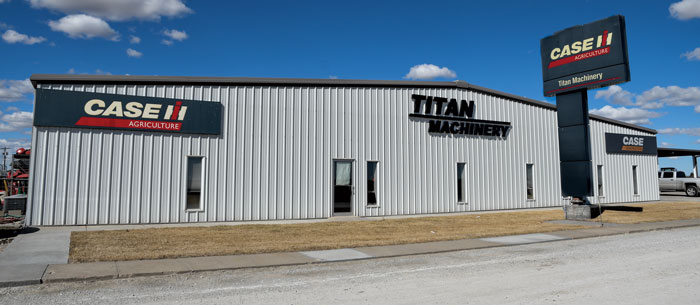
General Manager Marcus Dunbar is feeling “slightly disappointed” where store sales are sitting so far, “but I’m not surprised, and I anticipate the rest of the year being somewhat solid,” he says. “Barring a huge weather event, there’s potential for some decent yields — not over and above and not what they were originally predicting, but I’m saying a decent year.” John Dobberstein
Economically, General Manager Marcus Dunbar is feeling “slightly disappointed” where store sales are sitting so far, “but I’m not surprised, and I anticipate the rest of the year being somewhat solid.
“Barring a huge weather event, there’s potential for some decent yields — not over and above and not what they were originally predicting, but I’m saying a decent year. It would also help if we had a slight bump in prices or some bills passed that would directly support the ag sector. I would I anticipate the year to finish well overall.”
Keeping It Moving
Titan Holdrege depends on its “Uptime Program” for preventative maintenance to get as many farmers signed up as possible to visit the shop during the spring, summer and fall so parts can be ordered and be on hand and maintenance can be performed in a timely manner rather than facing untimely breakdowns.
“There’s always somebody, especially this year when interest rates are high, their carrying costs are high and they’re waiting until the end to see if they’ve got a crop to harvest,” Dunbar says. “We have several people wait and we anticipate who’s left and who potentially is going to do that. We do our best to have enough parts to not only fix those but to have parts on hand for the harvest season.”
Keeping the absorption rate high at dealerships is a major focus for Titan Machinery dealerships, and while Dunbar couldn’t get into specifics about his business, but he did describe how service techs are kept busy to avoid gaps in throughput with service jobs.
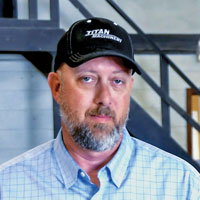
“It’ll shock you with some of the things that are not available. But overall it’s a workable environment. Now you can source things from other places or other dealers…”
“There are times that we have two or three items in the shop and we’re still waiting on parts, but that has gotten better over the last year and a half. Shop space is at a premium,” he notes. “We don’t have a huge shop where we can park 3 or 4 units in there for each technician to work on. But we do the best we can to get them in and out of the shop in a timely manner.
“And then you’ve got vacations that always hit, and summertime hits and people want to be outside doing other things. It slows the process some, but everybody’s dealt with it for a long time.”
Dunbar says they do their best to keep everyone happy, and some days that goes better than others.
“But you try and create a culture where one individual will go help another individual if their area of expertise is a little higher than the others, in that instance,” he says. “Cross training and personnel training is huge.”
With the push for Pinnacle-level service, many dealerships face a dilemma with labor rates, trying to balance keeping customers happy with recouping the costs incurred to fix complicated problems on short notice and paying for the voluminous training requirements for service techs.
As techs become more efficient at fixing equipment, “you have less of an issue,” Dunbar says. “We handle it on a case-by-case basis. It depends on the age of the equipment and the expertise involved. If somebody brings their H or their M in to get a wiring harness or put a new starter put in, 95% of the employees here could do that.
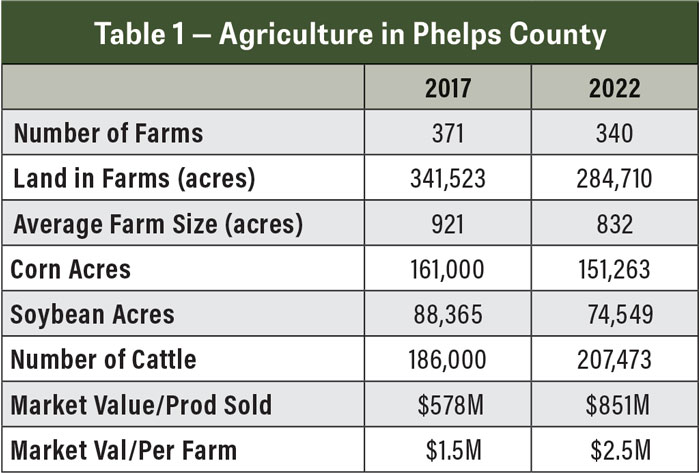
Although average farm size and the number of farms in Titan Holdrege’s home county have shrunk slightly, the market value of products sold continues to increase, primarily on the strength of livestock industry sales that rank No. 6 in the state, according to the USDA’s Census of Agriculture. Source: USDA
“But what if they bring in a new Magnum and with connectivity issues, fuel/emissions issues, GPS streaming data, or something in the CANBUS that takes expertise, and you have a service tool that’s $13,000 to $15,000? Plus you have certain unlocks and those are required every year — you’ve got to send technicians to training offsite for a week.
“So you’ve got expenses there and we handle it on a deal-by-deal basis a lot of times.”
On the road, Dunbar and his service manager, Joanna Bantum, work to get techs in the best position to cover service calls closest to them without unnecessary driving. “Having GPS on all the service trucks is useful so you can locate your technicians without calling,” he says.
“Sometimes the cell phone isn’t the best for communication, but at least you can see this person is on his way back. As he’s coming back from this service call, you could reroute them over to the next customer. Those little items that have a huge impact on efficiency and just taking care of the customer.”
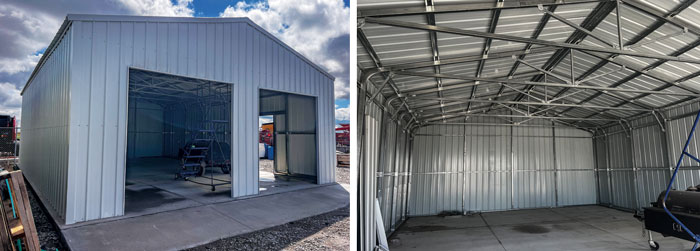
Titan’s store in Holdrege recently finished construction of a parts addition so deliveries that come overnight can be stored in the same place and out of the elements. John Dobberstein
One brick-and-mortar solution the Holdrege store added to aid in service efficiency is a new addition for overnight parts received from Lantern Delivery Systems so the parts can be under a roof and stored out of the elements. The parts often arrive after midnight when no employees are present.
“Sometimes you get parts that are a little expensive, so now (the delivery person) can throw them under a roof. We’ve got more room to keep parts under a roof and be able to access it easier, making us more efficient,” Dunbar says.
‘Wait & See’ on Macro Trends
While the Holdrege store’s tightknit group of employees are taking care of business at home and prepare for full-blown harvest time, economic waters continue to churn in the background.
Some relief from trade tensions between the U.S. and foreign countries seemed possible this spring, but as of mid-September farmers are still complaining about poor near-term access to markets for their products. China still hadn’t ordered soybeans from U.S. farmers, leaving a gaping hole in demand.
Record corn harvest acres were being forecast by the USDA with strong export prospects, although yield estimates were reduced a bit. But due to high input costs, stagnant commodity prices and weather disasters, many farmers were projected to lose income this year.
Learn More
Read additional articles in this series and watch our Boots on the Ground video series, brought to you by Yetter Farm Equipment, at Farm-Equipment.com/botg-alliance.
For his dealership, Dunbar says the tariffs play out the most with parts availability, but that hasn’t reached a crisis level yet. Supply levels are nowhere near where they were pre-COVID.
“I don’t want to call it the new norm, most things are available,” he says. “It’ll shock you with some of the things that are not available. But overall it’s a workable environment. Now you can source things from other places or other dealers. And one thing that came from COVID everyone’s willingness to share to keep people going, even with some of the competitive dealers, so there’s a positive.”
Another thorn in the side of many dealerships has been interest rates, which hadn’t been reduced in about 10 months until September, when the Federal Reserve dropped the key rate by 0.25%. The agency hinted more reductions could be forthcoming.
Dunbar says he was hoping for a drop of 0.25 to 0.50% by the end of the year.
“The real effect will not be applied to us immediately, as most of our lending options borrow their money on a long-term basis to better blend their rates,” he says. “The local banks will be better for our customers, which will help.”
Working the ‘Right to Repair’
The much-debated Right to Repair issue has come full circle now and it’s a reality that equipment dealerships are forced to manage. Dunbar hasn’t seen it become a major problem for the store and doesn’t plan to let it become one.
Titan’s policy is that customers can come to the parts department to order and purchase a service tool that is the same thing that the store purchases for its technicians to make a repair and pay for it over the counter like a parts purchase.
“They can buy all the individual unlocks that they require, whether it be toward the emissions, toward hydraulic repair, an AFS connect, any of those things,” Dunbar says.
“Sometimes you get parts that are a little expensive, so now the delivery person can throw them under a roof…”
“For CNH that’s their stance on the matter for now, to give the customer access and from there if they can figure it out, good for them. But there’s a lot of training involved that goes into learning how to use it. A smart individual that’s computer literate can figure it out.
“It gives you all the same parameters that we have. If you’re cautious, it’s fine, but somebody could get in there and mess some things up, too. As a producer or for myself, I have a diesel pickup, I work on the thing myself. I take it to the shop for warranty work, but it’s mine, I’m going to do what I want to the thing.
“I have the same philosophy and Titan and CNH all do as well toward the customer that purchased something while it’s in warranty you play by the rules, this is what we must live with. But if you want to buy an EST and you want to fix the equipment yourself, for the most part they allow you to do that.”
Farm Equipment's Boots on the Ground series is brought to you by Yetter Farm Equipment.
Yetter Farm Equipment has been providing farmers with residue management, fertilizer placement, and seedbed preparation solutions since 1930. Today, Yetter equipment is your answer for success in the face of ever-changing production agriculture challenges. Yetter offers a full lineup of planter attachments designed to perform in varying planting conditions, multiple options for precision fertilizer placement, strip-till units, and stalk rollers for your combine. Yetter products maximize your inputs, save you time, and deliver return on your investment. Visit them at yetterco.com.