

Brought to you by:
In this episode of the Farm Equipment podcast is brought to you by Machinery Scope, Managing Editor Christine Book sat down with John Fulton, a professor with Ohio State Univ.’s Department of Food, Agriculture and Biological Engineering.
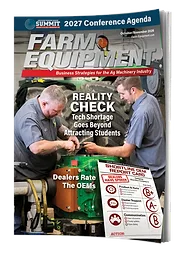
Christine sat down with Professor Fulton while working on Farm Equipment’s first-ever special report on careers in precision ag for the October/November issue of the magazine. The report provides a number of resources to help both the equipment business and it’s precision talent navigate the career opportunities that exist for in-coming precision staff.
The focus of the Ohio State program is to develop precision nutrient management strategies and technologies to improve efficiency of fertilizer placement, enable on-farm evaluation, automate machine functionality, enhance placement of pesticides and seed and to develop analytical tools for digital agriculture.




|
|
|
|
This episode of Farm Equipment Podcast is brought to you by Machinery Scope.
At Machinery Scope, we’re more than a warranty provider—we’re your partner in closing deals, protecting margins, and building long-term customer relationships. Our flexible programs are designed to work with your sales process, whether you're selling new or used equipment, on the lot or online.
We help you stand behind what you sell with fast quotes, prompt claims, and insured coverage that builds buyer confidence. Plus, we pay fairly—retail labor rates, travel time, and MSRP on parts—so you and your customers stay protected without the hassle.
When you work with Machinery Scope, you’re backed by a team that’s been in your shoes—and works like you do.
Full Transcript
Kim Schmidt:Hi, I'm Kim Schmidt, Executive Editor of Farm Equipment. Welcome to our latest episode of Farm Equipment's Podcast. In this episode, Managing Editor Christine Book, sat down with John Fulton, a professor with Ohio State University's Department of Food, Agriculture, and Biological Engineering. Christine sat down with Professor Fulton while working on Farm Equipment's first ever special report on careers in precision ag for our October-November issue of the magazine. The report provides a number of resources to help both the equipment business and its precision talent navigate the career opportunities that exist for incoming precision staff.
The focus of Ohio State's program is to develop precision nutrient management strategies and technologies to improve efficiency of fertilizer placement, enable on-farm evaluation, automate machine functionality, enhance placement of pesticides and seed, and to develop analytical tools for digital agriculture. This episode of the Farm Equipment Podcast is brought to you by Machinery Scope. Let's jump into the conversation now, as Christine and John discussed Ohio State's Precision Ag program and how John characterizes the growing focus on digital agriculture and emerging technology.
Christine book:This is Christine Book, Managing Editor of Farm Equipment Magazine, with Professor John Fulton of Ohio State University. And I'm here to basically get your sense of what's the latest at OSU in precision ag, latest offerings per se. And what do you feel that our audience needs to know by way of getting a sense of where precision ag education is and whether it's the rise of its increasing interest from students due to emerging technologies or general overview of its...? It's the hottest thing in ag, quite frankly. So, I'll leave it at that and I will let you address what do we need to know now about precision ag education.
John Fulton:Yeah, you bet. Well, thanks Christine. I appreciate the question. And that's one that we definitely spent a little time talking about on a routine basis, about how we can expand our offerings and educational experiences here at Ohio State, whether we call it precision ag or digital ag. So, new on our frontier is we've been working. We've got five courses on the book that deal with, we'll say precision or digital ag, anything from fairly introductory type, bringing awareness, and exposure to the technologies, and data science, and political pieces that we're starting to see, to the actual hardware and field application type implementation of all those. So, those five courses give students a pretty solid background within a four-year degree. And then we intertwined with that, and encourage students to do internships. And that would be typically during three months of summer term.
And we see that has really grown in the past five or six years, students going out, whether that be with a large corporation or a local dealership, or service provider, doing internships. And a lot of times those have precision ag emphasis on them. And so, additionally, we're also continuing to try and grow, just continuing education type opportunities both for students or those in industry as well. As you mentioned, it's pretty hot topic, it's growing. And so, we try and also offer, whether that's kind of like the precision ag CCA type content or actually continuing learning type, whether that's with a one-hour webinar or a multi hour, slash, half day, full day type experience and education for folks.
Christine book:That sounds terrific. Can you detail, one of the first things you mentioned was precision ag and digital ag? So, is it intertwining one into the next right now? Is that how both the university and the industry, as far as education goes, is pursuing it? Is that the next level of precision ag education that you see happening?
John Fulton:Yeah. So, traditionally, over the last 30 years, we've tended to focus on precision agriculture. And the way I differentiate precision versus digital is precision is really the hardware and the basic type services that you see offered, like precision soil sampling, some basic mapping, creating crop production reports or prescriptions, those kinds of things. That's precision. What we got into was trying to differentiate some of the newer type analytical aspects to it. So, we have both faculty and then research that's going into the analytics, which includes artificial intelligence. But really, doing the data analysis and bringing new learnings as we collect these volume of data coming off of farms and fields today, bringing that in.
So, thinking about the data being more in the digital, we see precision ag under the digital ag umbrella, because there's a lot more going on that includes precision livestock. Now, we see things like controlled environments getting into precision about plant by plant type management. So, that all falls under the umbrella, including the analytical aspects of having predictability within these systems or modeling, those kinds of things. All that falls under digital ag.
Christine book:That's really good to know. And knowing that you're a big part of the International Society of Precision Agriculture, ISPA.
Kim Schmidt:We'll get back to Christine's conversation with John Fulton in a moment. But first, I wanted to thank our sponsor, Machinery Scope. At Machinery Scope, they believe equipment owners and dealers deserve better, better protection, better support, better value. They're a family-owned team that's farmed the land, turned wrenches, and sold iron, so they get it. Machinery Scope's extended warranty solutions are flexible, valuable, and fast, with insured coverage you can count on and service that keeps deals moving. Whether you're protecting margins or equipment, they've got your back. Machinery Scope, raising the bar for the people who keep the industry running. Let's get back to the conversation now with John sharing more about the International Society of Precision Agriculture and how it's helping universities, colleges, and industry create courses, create course content centered around precision or digital ag.
Christine book:And you've mentioned that there's a compendium there of precision ag courses that are being taught at OSU, but also others being taught across the globe. Do these members and does the association work closely together to keep moving the needle in this direction? You see this, obviously the, sounds like a force multiplier with all of the data that is involved into emerging technologies.
John Fulton:Yeah. So, at the society level, as you mentioned, International Society of Precision Ag, a couple of years ago, we found getting a lot of questions because more and more universities, colleges, and even industry had asked us a little bit about teaching precision ag, digital ag topics. And so, to try and help facilitate people, give them resources to be able to create content, create a course, we've been trying to put information together. One of those key elements I thought that we did was we just built a database that our members can have access to. So, we basically had asked all the members and nonmembers. But we reached out and asked to fill out a form telling us about the course, like what level, what the number is, what the course title, who's the instructor.
A little bit of information or description about the course, along with if instructors or lecturers were willing to submit, we take the syllabus. So, that way we had this database, that if you were someone looking to start a new course or wanted to see what others were teaching, you could go to that database, and go down through there, and use that as a tool in that development work. And so, that's been very positively received. We see a lot of universities or faculties, basically young faculty, new faculty, using that as a tool to help them develop new coursework at their particular institution.
So, we as a society look at... not only are we trying to promote precision ag, digital ag, but we want to make sure that education in this is very important. Obviously, that could be at the ground level to student level, to even professional level. Today, we're getting a lot of questions because folks are even working in the industry, may come over and work in the technology division and may not have a background on, we'll say precision ag. And so, they want a quick course that they can go to. And, okay, what is precision ag? Tell me about some of those technologies, how it's being used, what kind of value it brings to farmers. So, we're trying to promote, encourage that amongst our membership. And so, we're trying to be that facilitator to society for some of that education.
Christine book:Such an important role to play in that collaboration behind curriculum, both with educators and those putting in practice every day. It's just really impressive and certainly something we'll be following as well. And then lastly, Professor, I would ask, as it directly relates to ag equipment dealerships, and basically, you're feeding that pipeline of the workforce, how's the outlook? How are you seeing it with incoming students, whether it's an increase in the number of them or the impact and the number of dealers that you're working with? How would you characterize that?
John Fulton:For us, I'll speak to Ohio State, very positive. We have had students graduate and be plugged right into a precision ag dealer or service provider at different levels. And what I mean by levels, that could be someone at a equipment dealership or an input supplier, or a retailer co-op, to a large company, but the prospects are very positive. Pretty much a lot of the jobs that are put out there, our students are able to attain those. And so, we're getting very good placement today out of our program. And the job opportunities have still remained fairly strong. Even though we're a little bit tied here in the farm economy, we're still seeing students get hired on, especially in these technology positions.
Christine book:So appreciate your insight, and your input, and your learned experiences that you're sharing with us and our audience. And we'll definitely keep following up. I know your part of the Precision Farming Dealer Summit coming up in 2026, and everyone will look forward to hearing your expertise there. And the approach you take in making sure that the industry is kept up to speed is certainly going to be something that we'll follow in an ongoing series, because the education never ends. We sit with precision managers and service folks all the time, just recently in Iowa City for our Dealership Mind Summit. And it was much the same. It was the learning curve is coming fast, the technology is coming fast, and we appreciate you being on the cusp of all of that, and taking your time to share your expertise with us.
John Fulton:Yeah. But I appreciate it. And just to kind of re-emphasize your point there, Christine. The technology front is changing very rapidly here. We're seeing a lot of new technologies come. And so, it's exciting to see what's coming, but as you mentioned, we've got to be ready for it too.
Kim Schmidt:Thanks to John Fulton for joining us for this episode of the Farm Equipment Podcast and providing some great insights into precision education. You can read more from the interview, as well as check out the full career and precision ag report in the October-November 2025 issue of Farm Equipment, available now at farm-equipment.com. And if you've got topics you'd like to hear us discuss in future podcast episodes, be sure to email me at kschmidt@lestermedia.com. Until next time, thanks for joining us. I'm Kim Schmidt. Have a great day.