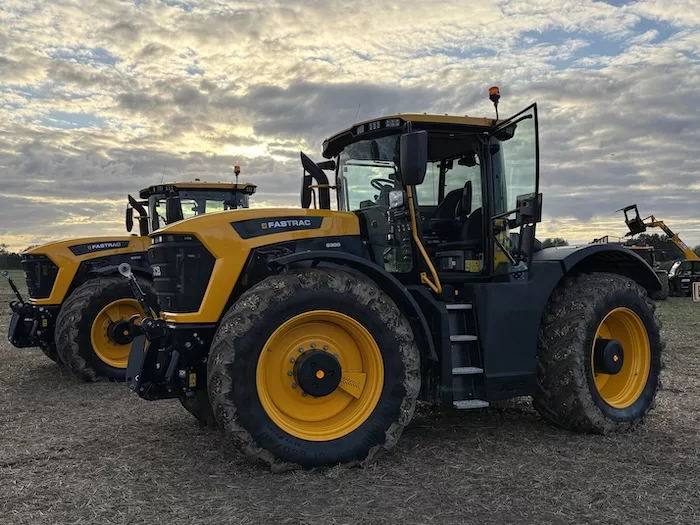
During a press event at its world headquarters on September 24, 2025, JCB launched an all-new series of its Fastrac high-speed tractor to provide farmers and custom operators with a feature-laden, highly productive power unit suited to a multitude of field and transport tasks. The new models will be available to North American customers in Q2 2026.
The new series fills the gap in the Fastrac range between the 4000 Series (160-240 horsepower) and the 8000 Series (330+ horsepower).
JCB Agriculture Managing Director John Smith said, “The all-new 6000 Series stays true to JCB's innovative and groundbreaking concept that defines all Fastracs, resulting in an exceptional combination of productivity, efficiency, versatility and operator comfort. It also takes the JCB Fastrac into a new power and performance category, meeting the needs of farmers and contractors with outstanding features that create a highly productive machine with unique capabilities in the field and on the road.”
Fastrac 6000 Series Models
There are two models of the new Fastrac with selectable two- and multi-mode four-wheel steering as standard, and a maximum top speed of 41 mph (66 kph).
With peak power outputs of 284 hp (212 kW) from the 6260 and 335 hp (250 kW) from the 6300, the newcomers complement the current 37 mph Fastrac 4000 with up to 235 hp (175 kW) and the 43 mph Fastrac 8000 with up to 348 hp (260 kW).
New optional features include a fully integrated tire inflation management system providing quick access to optimal field and road pressures and a satellite guidance installation comprising two receivers for quicker and more precise line acquisition, more accurate tracking over an undulating field surface and enabling Twin Steer ultra-precision guidance that steers both axles.
On Farmin' Aint Easy's Youtube channel, they gave their impressions of the new Fastrac. Check it out below.
Chassis and Powertrain
A new chassis concept conceived for the Fastrac 6000 Series comprises a cast front section supporting the engine, front axle and optional front linkage and PTO, and a steel-fabricated structure carrying the cab, transmission, rear axle and lift linkage, hydraulics and PTO.
The heavy-duty casting is sculpted to allow the tightest possible front axle steer angle and is pre-prepared to make it easy to fit front loader brackets.
The new chassis also helps meet the objective of keeping the engine installation as narrow as possible for the best view from the cab to the front wheels and beyond.
This was also one reason for choosing the 6.7-liter FPT NEF67 six-cylinder diesel engine – it was considered the best fit, literally and performance-wise, for the new Fastrac.
The engine is tuned to deliver peak power at 1,850 rpm alongside a torque curve that rises as the revs are pulled down under a heavy load to peak at 1,400 rpm, generating 940.4 foot-pounds of torque for the Fastrac 6260 and 1,032.6 foot-pounds for the 6300.
At least 95% of the max torque output is delivered across a 600 rpm band from 1,200-1,800 rpm, providing plenty of backup “grunt” when cultivating into a patch of tougher ground or when pulling up an incline on the road.
The engine’s performance is power-matched to a well-proven ZF Eccom 3.1 stepless transmission, which delivers imperceptible on-the-move auto shifting among four ranges that provide a high proportion of mechanical drive efficiency at key field and transport speeds.
With lively acceleration and no power interruption from zero to 41 mph, and no manual shifting between field and road ranges, the new engine and transmission pairing is managed by JCB’s Smart Transmission Control and adapts to different applications for optimum productivity and efficiency.
Hydraulics and Power Take-Off
The new JCB Fastrac 6000 Series tractors have a high-output variable-flow hydraulics package to handle the considerable oil demand of large, modern implements, with a dedicated hydraulic oil supply separate from the transmission, eliminating any risk of cross contamination.
Max pump output is 54 gpm as standard, with the Fastrac 6300 optionally available with a 106 gpm twin pump installation to cater to the most demanding implements, such as large air seeders.
The new hydraulic valve block has lever-operated push-out, pull-in couplings and a power-beyond circuit is available, delivering a flow of oil to implements on demand.
At the rear, a 24,250-pound three-point linkage – attached to the back axle to retain full suspension movement under load – and four-speed power take-off cater for all implement types.
The optional 11,023-pound lift front linkage is complemented by a 1,000 rpm power take-off with the new feature of a six-spline and 21-spline shaft, reversible just by removing a circlip, which adds to the tractor’s versatility with a wider selection of front-mounted power-driven implements.
In addition, the Fastrac 6000’s unique 11,023-pound capacity rear load deck provides a third mounting location for equipment such as a sprayer or a liquid tank supplying fertilizer to a potato planter.
Tire Inflation Management
JCB engineers have developed the fully integrated central tire inflation system (CTIS) as a single-line package passing through the front and rear axles and then via rotary seals to the rims, with special design features aimed at reliability, minimal maintenance and a long service life for key components.
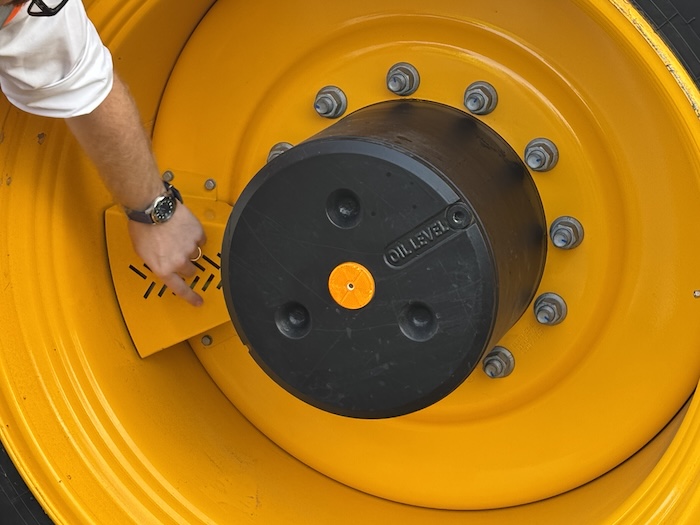
Heat and contamination are potential hazards that can cause rotary seal issues, so the new Fastrac CTIS has a blast cooler to reduce the air temperature as it heats up under pressure, and the air is exhausted at the rim valve rather than being returned through the system to eliminate contamination risk when the tires are being deflated to field pressures.
Two 315cc compressors provide an airflow of up to 159 gpm, enabling four 650/60 R38 tires to be inflated from, for example, 14.5 psi (1 bar) to 29 psi (2 bar) for road travel in just over four minutes, and deflated once back in the field in less than a minute.
The key benefit of this system, which is controlled using the tractor’s iCON touchscreen display, is the convenience of switching between optimal field and road pressures, with fuel efficiency benefiting in both cases.
In the field, low pressures allow the tire wall to flex and increase the size of the tire-to-soil contact patch, giving the tractor maximum traction and minimal impact on soil structure.
Pumping air into the tires for road travel adds stability and preserves the performance, road-going characteristics and longevity of the tires, especially over the long runs at high speeds for which the Fastrac is uniquely equipped.
Hydro-Pneumatic Suspension
The Fastrac’s unique self-leveling advanced suspension at both axles gives the new 6000 Series tractors the highest levels of driver comfort and well-being over long working days – an attraction that can help keep experienced operators engaged long-term in a farming business.
It also enables the tractor to achieve maximum traction with minimal ballast by shifting forward the weight of a mounted implement, such as a plow or cultivator, closer to the Fastrac’s 50:50 unladen weight distribution, and by keeping the tractor’s tires firmly engaged with the soil, especially over rough surfaces.
When operating demountable equipment on the rear deck, the hydropneumatic system enables the tractor to “squat” as it reverses beneath a parked sprayer or spreader, resulting in easy, effort-free coupling – drive in, raise the suspension, lock the mounts, retract or remove the parking legs.
External Disc Brakes with ABS
Major advantages for the Fastrac are large externally mounted brake discs and calipers, front and rear, providing exceptional air-powered braking performance, natural air cooling, and unfettered access for inspection, servicing and maintenance.
There are two significant enhancements on the Fastrac 6000 Series: first, a brake pad wear indicator to avoid the risk of worn pads going undetected and the discs becoming damaged and second, discs attached to (rather than behind) the reduction hubs so there is no need to remove the hub to replace them.
That process can be completed in just three to four hours – in stark contrast to the two to three days required to change a conventional tractor’s internal brake discs.
Electronic ABS anti-lock control maximizes braking effect while preventing uncontrolled skidding on hard-surfaced roads and loose-surfaced tracks, while 2WD Traction Control kicks in to prevent the rear wheels from scrabbling for grip when turning from the road onto a rough- or loose-surfaced field gateway.
Intelligent Steering
New front and rear steering axles developed jointly with Dana carry 38in or 34in rims all round shod with factory-fitted 600mm, 610mm or 710mm wide high-speed tires. Both axles are approved for dual-wheel fitments for added traction, flotation and side-slope stability.
An enhanced version of JCB’s well-established four-wheel steering system has hydraulic rather than mechanical locking for smoother transitions between two-wheel and four-wheel steer, proportional to forward speed.
There is also the important safety feature of a ground-driven pump that ensures the steering remains active should the engine stall or cut out.
Several modes of four-wheel steering are engaged through the Fastrac’s iCON display, and when traveling at road speed, four-wheel steering automatically cuts out to ensure stable and predictable characteristics in two-wheel steer. The system then reverts to four-wheel steer maneuverability.
Apart from providing a competitive turning radius at the end of the field, four-wheel steer is especially valuable when turning a long trailer or implement into a field entrance, while modes such as True Tracking and Rear Delay are helpful when working in rows and beds.
Unique Twin Steer
The Fastrac’s unique Twin Steer system is available through JCB GPS, which utilizes two NovAtel receivers; it controls the two axles individually, so the tractor can steer crabwise directly to the guideline across a steep slope if a correction is needed to keep an implement on track.
In contrast, a two-wheel steer tractor must first turn toward the guidance line, causing the implement to be briefly pushed further away from its designated path, go briefly beyond the guideline and then back again to get the implement on course.
JCB’s Twin Steer system has proved highly effective at maintaining accurately spaced and positioned rows when sowing high-value vegetable and salad crops grown in beds, and at eliminating damage to crops or beds, especially during multi-pass operations – and all without the added expense, weight and complexity of an implement side-shift mechanism.
iCON Digital Technologies
Together with the new option to add a second 12-inch color touchscreen display, providing more area to show tractor and implement information such as GPS guidance and ISOBUS, JCB software engineers have developed an enhanced version of the iCON digital operator/machine interface at the heart of the new Fastrac’s operating systems.
The new version provides even greater flexibility for populating the display screens with bespoke content of the operator’s choice, so that different screens can be called up to show the information – such as guidance, camera view, ISOBUS, section control, etc. – most relevant to individual field and road tasks.
Also, operators can create multiple profiles of control setups, tractor and implement settings, saving them for quick recall when next carrying out the same operation.
Grouped under the iCONNECT banner are JCB LiveLink telematics for remote tractor monitoring and records, and optional ISOBUS, which comprises Universal Terminal, Task Controller and Aux-N auxiliary control allocation, with the option to upgrade with Section and Variable Rate Control.
JCB’s own factory-installed satellite guidance option is another iCONNECT function, this unique package having two NovAtel satellite signal receivers as standard, installed securely out of sight in the left- and right-hand sides of the cab roof panel.
This setup provides highly accurate low-speed guidance, increased accuracy over undulating terrain compared with a single receiver, and quicker, more precise acquisition of pre-set guidelines, reducing the amount of side-to-side oscillation at the start of the pass.
Also, in addition to straight-line and curve guidance, the system now provides a choice of headland turn pathways to increase ease of use through automation and boost overall productivity.
Lighting and Remote Viewing
The new Fastrac tractor’s familiar and uniquely spacious two-seat cab is adorned with powerful LED work lights neatly set into the front and rear of the roof panel, supplementing those set into the engine hood grille and mounted on the cab ‘A’ post to provide bright 360-degree illumination.
Also contributing to the operator’s all-round view is a standard-fit trailer hitch camera and a new digital camera combination option comprising a front-mounted 180-degree fisheye lens to help when emerging from a field onto a road, and a 120-degree camera at the back of the roof panel, both feeding images to the iCON display.