My initial reaction to no-till was “this will never work. You’ve got to plow the ground and kill the weeds, or the weeds will overtake it.”
I wasn’t the only one who was skeptical of no-till. Both farm equipment and chemical dealers were in the “this will never work” mindset. They questioned weed control and whether the herbicides would work.
While farmers were also in the same mindset, they were willing to listen because they were open to doing something different, if it meant cutting costs or increasing yields. It was, “I’m willing to listen, but it’s going to take some convincing.”
BASF introduced Basagran herbicide in 1970, which you could use to control weeds in no-till soybeans. The company had been looking for new ways to plant soybeans, because their research indicated growers could get better yields with narrower rows. But obviously if the rows were narrow, you couldn’t cultivate.
With no-till and Basagran to control the weeds, there was no reason not to try narrow rows. BASF realized there was going to be a big opportunity if this idea worked.
We initially worked with BASF on narrow-row beans in conventional tillage. That worked well, but we could both see a real advantage to no-till narrow row — initially for double-cropped soybeans.
“My initial reaction was that no-till will never work…”
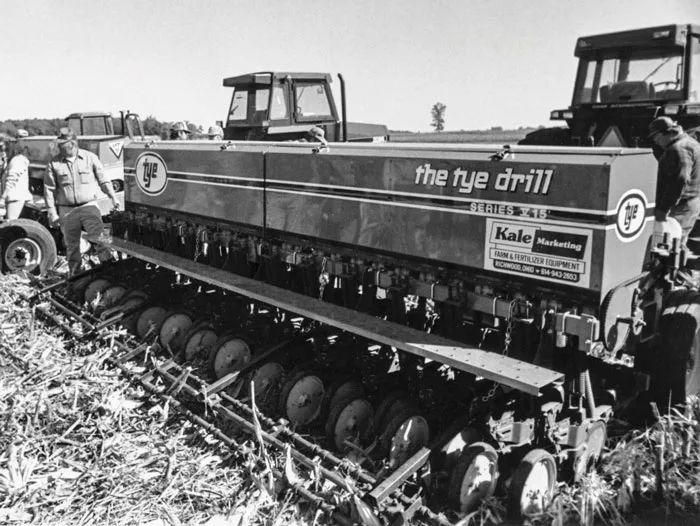
So we got together with BASF and configured some drills with crude, homemade coulters to no-till soybeans in 8-inch rows. It worked, and that’s how we got started in no-till.
We then branched off into no-till pasture renovation at the request of Texas A&M University agronomists. They wanted to reseed grassland and pasture ground, but didn’t want to rip up all the ground before seeding it, which was the current method.
So we put a couple no-till seeders together for the Texas A&M people to try. That’s when we came up with the idea that you needed fairly small no-till drills, because the tractors were light on horsepower.
Manufacturers Catch Up
The earliest folks in manufacturing no-till equipment were Allis-Chalmers, who had no-till planters, and the Fleischer folks in Nebraska, who were promoting ridge-till and their Buffalo planters and cultivators. Both companies were ahead of their time, because we didn’t yet have the ability to control weeds with over-the-top chemicals.
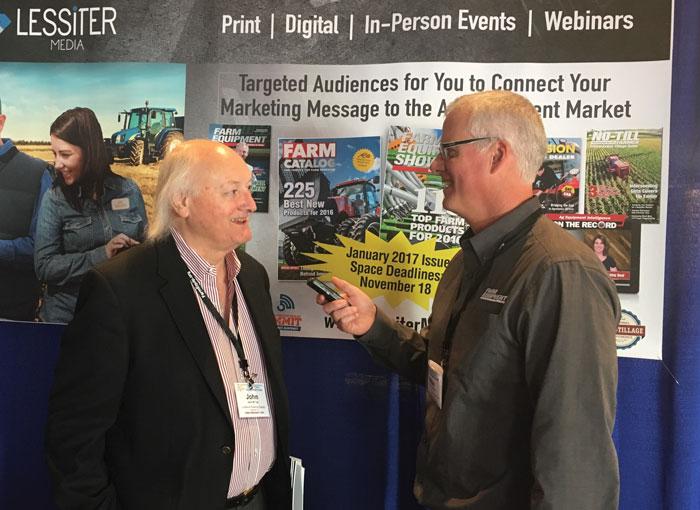
NO-TILL INNOVATOR. John Tye, shown at left, with Lessiter Media president Mike Lessiter says his company led the way when it came to developing early day no-till drill innovations. Darren Foster
When Roy Applequist with Great Plains got out of the bearing business and into the implement business, no-till was among several options he looked at. For a long time, it was just Great Plains, Crustbuster and us in the no-till drill business.
No Deere Green, No Red Case IH Tools
In those days, John Deere and Case IH ignored no-till, as it didn’t fit in with their program of marketing larger horsepower tractors, moldboard plows and wider and wider tillage tools.
John Deere later introduced a no-till pasture renovation machine that was developed by staffers at the University of Kentucky. It had all these gear boxes, fast rotating coulter-like things that looked like saw blades and it was expensive. The maintenance and upkeep were horrible, but this was Deere’s first run at no-till.
“Once John Deere signed onto no-till, farmers thought it must be OK…”
We did some work with John Deere after they decided they really needed to be in the no-till business. One of our first moves was to take a regular drill and hook it on the back of a carrier with a big bar and coulters. B.G. Schluetter in Illinois had patented the idea, so we paid him a royalty and made it marketable and manufacturable.
That’s when John Deere came to us and said, “We’d like you to private label that for us, too. We really need to be in the no-till business and we’ve got some new stuff coming up, but it’s not going to be here in time and we need to do something.” So we wound up making a few of these units for them, but never put an agreement together.
There appeared to be a big internal battle going on at Deere — the marketing folks wanted a product to be in the market immediately, but the engineering folks wanted to wait until they could develop their own. It appeared that the engineering side won.
A couple years later they brought out their first John Deere genuine designed and built no-till drill. And once John Deere signed onto no-till, farmers thought “no-till must be OK.”
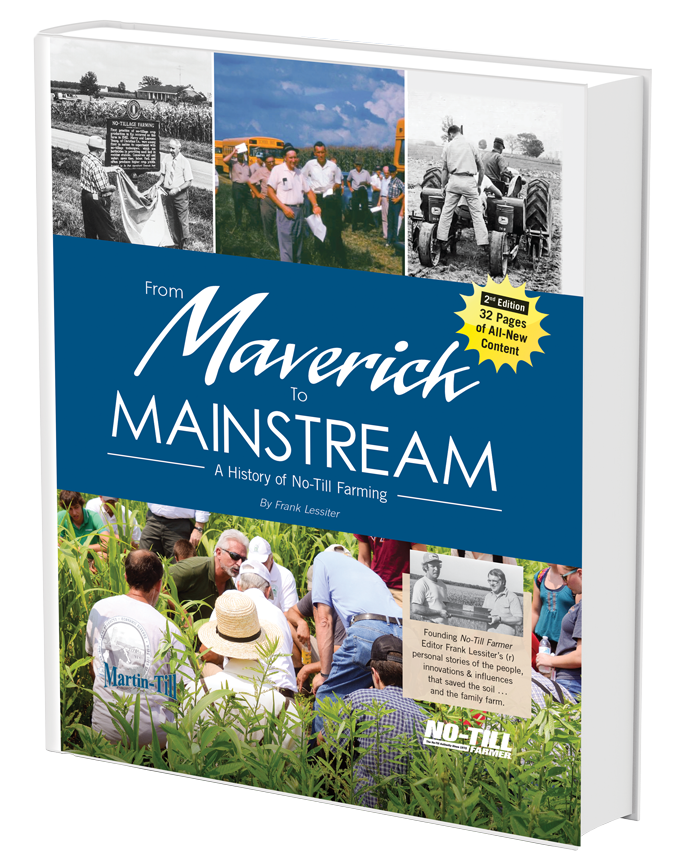
From Maverick to Mainstream:
A History of No-Till Farming
A must have book for anyone involved in agriculture. A stunning and unique collection of no-till stories, photographs, facts and figures chronicle the history of no-till farming from the early years through today. This extraordinary hardbound book takes a decade-by-decade look at the world of no-till as seen through the eyes of those who observed the many changes in no-till since the first commercial U.S. plot in 1962.
Here's what readers are saying:
“This book has intrigue, conspiracies, spies, strong-arm tactics and other shenanigans amid the search for the truth about no-till.” — Jeff Bowman, Titan Machinery, West Fargo, N.D.
"By the end of “From Maverick to Mainstream,” readers will have a better sense of the history of no-tillage and the people who were key to advancing this innovation. Even experienced or long-time no-tillers will get a behind-the-scenes look at the hurdles no-tillage faced, and its wins. Everyone will come away reminded of this fundamental truth: Everything starts with the soil." — Laura Foell, Schaller, Iowa
“It’s such a fascinating look at the beginnings of no-till to what it is today. It’s renewed my vigor in no-tilling and prompted me to try more ideas out instead of staying in a rut of the same old, same old.” — Carl Zimmerman, Earlville, Ill.